
Missing information?
Do you have any additional information you would like to share about a soldier?
Submit- Full
name
WILSON, John W - Date of
birth
27 February 1917 -
Age
26 -
Place of birth
Iowa -
Hometown
Des Moines, Polk County, Iowa
Personal info
Military service
- Service
number
O-729395 -
Rank
First Lieutenant -
Function
Pilot -
Unit
401st Bombardment Squadron,
91st Bombardment Group, Heavy
-
Awards
Purple Heart,
Air Medal
Death
-
Status
Killed in Action - Date of
death
17 April 1943 - Place of
death
Near Wunsdorf, Germany
Grave
-
Cemetery
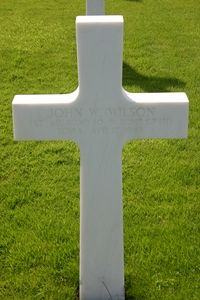
American War Cemetery Ardennes
| Plot | Row | Grave |
|---|---|---|
| B | 9 | 17 |
Immediate family
-
Members
William B. Wilson (father)
Alice J. Wilson (mother)
Wayne A. Wilson (brother)
Plane data
- Serial
number
41-24459 -
Data
Type: B-17F
Nickname: Hellsapoppin
Destination: Bremen, Germany
Mission: Bombing
MACR: 15520
Biography
www.angelfire.comMore information
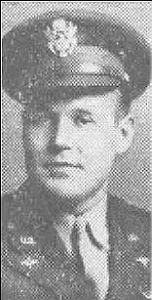
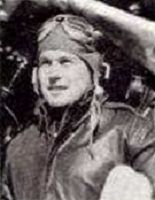
John W. Wilson attended the University of Iowa.The next 401st Low Squadron plane to go down was Hellsapoppin. Three or four minutes after the target there was a very hard jolt under the left side of the plane, close in to the fuselage. An anti-aircraft shell had exploded just under Hellsapoppin. Flak ripped into the left front side of the aircraft, flaking off chunks of metal from the fuselage and throwing them through the interior of the plane. At the same time, three feet of the right wing tip was blown off by a flak burst. A one and one-half foot hole appeared in the nose compartment and all the nose window Plexiglas blew out. There was fire in the left wing and nose compartment. The radio room became engulfed in fire from broken oxygen lines. The pilot, 1st Lt John W. Wilson, was wounded in the head and the copilot, 1st Lt Arthur A. Bushnell, in the right eye, both legs, left arm, and right hand by flying aluminum. In the nose the bombardier, 1st Lt Harold Romm, was hit in the left leg by flak. Earlier, before the target, Lt Romm had been hit in the same leg by a machine gun bullet during an attack by a FW 190. In the top turret, the flight engineer, T/Sgt Norman L. Thompson, felt the jolt and when he looked out, saw the left wing on fire. He had just seen a fighter off the left wing going after a plane below and was afraid it would come back up at Hellsapoppin. The enemy fighter was about 15 feet too low for Sgt Thompson to deflect his top turret guns to get off a burst. Since the intercom was shot out, Sgt Thompson was not certain what was happenig to the plane. He stepped down from the turret and went into the cockpit. There he saw both pilots with their oxygen masks off and blood pouring out from under their helmets. He assumed both were dead. Sgt Thompson had not heard any firing from the gunners since Hellsapoppin had left the target. He figured they either had been killed by the flak and fighters or were too seriously injured to move. From the intensity of the fire, he knew Hellsapoppin could explode any second. He took a final glance at the instruments to ensure the plane was still in level flight. He went back to the bomb bay and opened the doors, which still operated. After checking below and seeing there was no plane under him, Sgt Thompson dropped out. Almost immediately after he bailed out, the plane broke in two at the radio room. Four others somehow managed to escape the aircraft, Lt Bushnell, Lt Barton, Lt Romm and the radio operator T/Sgt Howard A. Earney. All were wounded. The rest of the crew remained trapped in the falling aircraft.
Source of information: FOHF, www.wwiimemorial.com, www.archives.gov, www.91stbombgroup.com, www.footnote.com,
Photo source: Astrid van Erp, Peter Schouteten, Arie-Jan van Hees, Pilot Class Book 42-H, Rankin, Texas.