
Missing information?
Do you have any additional information you would like to share about a soldier?
Submit- Full
name
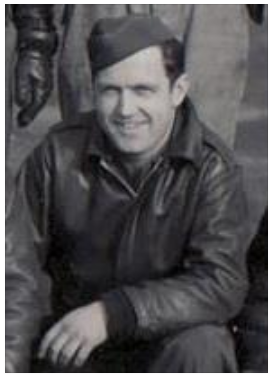
FAY, Vincent James - Date of
birth
9 March 1922 -
Age
22 -
Place of birth
New York -
Hometown
Queens, Queens County, New York
Personal info
Military service
- Service
number
32515044 -
Rank
Technical Sergeant -
Function
Top Turret Gunner -
Unit
364th Bombardment Squadron,
305th Bombardment Group, Heavy
-
Awards
Distinguished Flying Cross,
Air Medal with 3 Oak Leaf Clusters
Death
-
Status
Missing in Action - Date of
death
22 April 1944 - Place of
death
North Sea
Grave
-
Cemetery
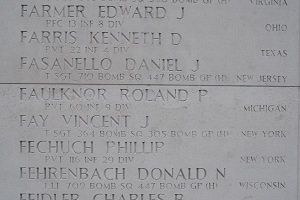
American War Cemetery Margraten - Walls of the Missing
Immediate family
-
Members
James P. Fay (father)
Ella (Lauro) Fay (mother)
Rosemary Fay (sister)
James L. Fay (brother)
Theresa Fay (sister)
Plane data
- Serial
number
42-39818 -
Data
Type: B-17G
Destination: Hamm, Germany
Mission: Bombing of the marshalling yard
MACR: 4354
More information
Vincent J. Fay attended Far Rockaway High School for three years and worked in a machine shop.He enlisted at Fort Jay, New York on 29 September 1942. He was sent overseas in September 1943
The airplane was flying at an altitude of 20.000 feet, over the North Sea, as deputy Group Leader at the time of the mishap. The first knowledge that the pilot had of the fire was when he turned around and found the compartment aft the cockpit a mass of flames. The Engineer, T/Sgt Fay, was apparently in trouble, as he was standing in the center of the fire, flailing his arms about, with 50 cal. bullets, and flares going off every second. The pilot removed all his flying equipment for his person, and in trying to keep his balance as he was leaving his seat, slipped and fell into the catwalk leading to the nose compartment. There he saw the Navigator, Lt Brandino, with an extinguisher in his hand trying to get the fire in that compartment under control, but not having any success. Lt Schellenberg grabbed the extinguisher and sprayed it on the flames in the cockpit, which was full of smoke, and the compartment aft of the cockpit.
The A/C, at this time was put into a steep dive by the Co-pilot, who was flying with his head out of his window since it was impossible to see out of the windows. The plane was pulled out of the dive at 6.000 feet, travelling at a speed of approximately 2500 MPH. The pilots parachute was sucked out of the plane through the escape-hatch in the nose as the door had been torn off by some cause that was unknown. The fire was eventually extinguished by the combined efforts of the whole crew and all the bombs except 6-500 lb bombs and one smoke bomb were salvoed by use of a screwdriver, as the automatic release were all burned out. The bomb-bay doors were sprung before the bombs were salvoed and it is believed that the Engineer jumped out through the bomb-bay. As soon as the fire was out, the pilot started to take account of the crew, and found that three members were missing. No one saw them bail out, but the area was circled and the radio operator gave fixes to air-sea rescue, who answered that message was received. Co-pilot and pilot flew the ship back to England, where they landed it safely at Bungay, England. The cause of the fire is unknown.
Source of information: Raf Dyckmans, www.wwiimemorial.com, www.fold3.com, www.findagrave.com, www.ancestry.com - Family Tree
Photo source: www.findagrave.com, Arie-Jan van Hees