
Missing information?
Do you have any additional information you would like to share about a soldier?
Submit- Full
name
PULASKI, Frank T - Date of
birth
1922 -
Age
unknown -
Place of birth
Massachusetts -
Hometown
West Roxbury, Suffolk County, Massachusetts
Personal info
Military service
- Service
number
O-736353 -
Rank
Second Lieutenant -
Function
Co-Pilot -
Unit
527th Bombardment Squadron,
379th Bombardment Group, Heavy
-
Awards
Purple Heart
Death
-
Status
Killed in Action - Date of
death
25 June 1943 - Place of
death
Neu Arenberg, Germany
Grave
-
Cemetery
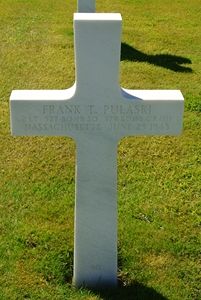
American War Cemetery Ardennes
| Plot | Row | Grave |
|---|---|---|
| A | 32 | 30 |
Immediate family
-
Members
Albert M. Pulaski (father)
Louise T. Pulaski (mother)
Lula H. Pulaski (sister)
Shirly (Norwood) Pulaski (wife)
Plane data
- Serial
number
42-29892 -
Data
Type: B-17G
Destination: Hamburg, Germany
Mission: Bombing of shipyards and submarine buildings
MACR: 1758
More information
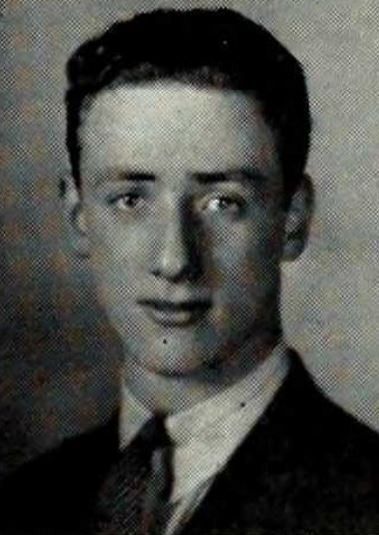
2nd Lt Frank T. Pulaski graduated from English High School in 1940. He attended Boston University School of Journalism. He was employed at the Christian Science Monitor.He volunteered for the Air Corps of the Army of the United States in Boston, Massachusetts on 17 March 1942.
The mission for that day was to attack shipyards and submarine buildings in the harbor of Hamburg. Due to bad weather, the visibility over the target was very poor. Instead targets of opportunity were attacked, being the airfield on Wangerooge Island.
Statement of 2nd Lt Thomas S. Mortenson, the surviving bombardier of the crew:
"We proceeded on a bombing mission to Hamburg, Germany, handicapped by a solid undercast. Several attempts were made to rendezvous with other Groups and Wings in the formation. While somewhere in the area of Bremen, the lead Group of the Wing was sighted far to the Northeast. Following the Group and Squadron Leader, we attempted to join the lead Group. At this moment the lead Group, making a 150 degree turn began the flight back to England. While making our turn, it was my impression that the Pilot was having trouble keeping the plane in formation due to lack of speed. We then became a straggler. The last word to come over the interphone were the Pilot´s to the Co-Pilot, ´Give her all you´ve got´. Then came a fighter attack from somewhere in the rear knocking the interphone out. To lighten the load and being over German territory, I (2nd Lt Mortenson) opened the bomb bays and dropped the bombs. We then made two very steep dives of approximately 7,000 feet each presumably to get into the cloud cover, upon which we had formerly agreed, if attacked or disabled. Several fighter attacks followed and upon leveling out after the second dive I entered the partly damaged Pilot´s compartment, the top having been blown off, and inquired if everything was under control. Due to the noise and rush of air, conversation was impossible. The Asst. Engineer operating in the top turret then informed me the plane was on fire and to get out. I pulled the emergency release for the nose hatch and the Navigator coming from the nose excitedly informed me ´the ship must be on fire´. I waited by the escape hatch for possible word from the Pilot, the Navigator and Asst. Engineer urging me to jump. I bailed out, seeing the plane pass over me, fire streaming from bomb bays to tail. During the descent the Asst. Engineer and myself witnessed our plane burn in half and crash while a FW 190 flew figure eights around us."
According to surviving crew members, 2nd Lt Pulaski was wounded and trapped in the bomb bay when they bailed out.
Five crew members were killed and were initially buried at the cemetery of Bad-Zwischenahn, Germany. Five men were taken prisoner.
Source of information: Raf Dyckmans, Terry Hirsch, www.wwiimemorial.com, www.fold3.com
Photo source: Peter Schouteten, English High School 1940