
Missing information?
Do you have any additional information you would like to share about a soldier?
Submit- Full
name
FOSTER, Robert George - Date of
birth
8 June 1921 -
Age
22 -
Place of birth
Inger Creek, Montgomery County, Indiana -
Hometown
Darlington, Montgomery County, Indiana
Personal info
Military service
- Service
number
O-736502 -
Rank
Second Lieutenant -
Function
Co-Pilot -
Unit
410th Bombardment Squadron,
94th Bombardment Group, Heavy
-
Awards
Purple Heart,
Air Medal with 2 Oak Leaf Clusters
Death
-
Status
Killed in Action - Date of
death
29 November 1943 - Place of
death
English Channel
Grave
-
Cemetery
American War Cemetery Margraten - Walls of the Missing
Immediate family
-
Members
David E. Foster (father)
Ruth W. (Seybold) Foster (mother)
David Foster (brother)
Don Foster (brother)
Donnis Foster (sister)
Marylou Foster (sister)
Patricia R. Foster (sister)
Lucille Foster (sister)
Plane data
- Serial
number
42-3352 -
Data
Type: B-17F
Nickname: Virgins Delight
Destination: Bremen, Germany
Mission: Operationel
MACR: 1186
More information
2nd Lt Robert G. Foster attended Crawfordsville High School. He joined the National Guard in January 1941.His aircraft was hit over Bremen, Germany by an artillery shell that pierced an engine making a large hole where fuel leaked out. The crew turned back to England and at treetop made it to the channel. The aircraft ditched after contacting Air/Sea Rescue. After all the crew got into 2 life rafts, a heavy fog covered them and although they could hear the rescue aircraft they were not found (about 3PM). By morning only the Pilot 2nd Lt Chyle Walter, Co Pilot 2nd Lt Robert G. Foster and the Bombardier 2nd Lt Maximowicz Peter P were alive but near death from exposure. The pilot was the lone survivor. He was found, healed and a POW.
From The Courier Journal May 28 1984:
"The nightmarish ordeal of 2nd Lt. Walter Chyle Jr. and his nine man crew began Nov. 29, 1943 when the B-17 Bomber on which Chyle was first pilot was hit by enemy ground fire after a bombing raid near Bremen, Germany.
Without his No. 4 engine and unable to keep up with his bomber squadron, Chyle dropped his plane to tree top level and led seven German fighter planes on a hedgehopping chase over Germany and Holland toward the North Sea. Across the sea near Bury, St. Edmunds, England, lay his air base. Two of the German fighters were shot down, and the other five gave up about 20 miles out to sea, recalls, Chyle now 65. Lt Chyle nows that he have not enough gas to get to England, but he established radio contact with England. And they had him keep talking, so they could get a fix on they location.
Eventually the No. 3 engine quit, and shortly thereafter the No. 1 engine began to sputter. As the plane neared stall speed, Lt Chyle was advised by radio that he should ditch the aircraft. They said, “You’re 45 miles from the coast and we’ll be out there to get you in a little while..”
About 4p.m. on the afternoon of 29th the 10 man crew evacuated the plane safely and set adrift in rubber life boats tied together, (5 men in each raft) minutes before the big bomber “Virgins Delight”sank in the icy waters of the North Sea. As the men waited for help a tremendous storm blew up with monstrous waves that tossed the rafts into the air, capsizing them numerous times, dumping all their emergency provisions, and carrying their rafts a considerable distance from where the plane had been ditched. Although no one drowned during the storm, within 4 hours one crewman, who was sitting next to Chyle in chest-deep water inside the raft, began to nod forward as if dozing off, and a few minutes later was dead from the effects of the cold.
The miserable night passed with only brief conversations, and fog was so dense the next morning that Lt Chyle could not see the second raft, trailing his own by 30 to 40 feet.
Two more of the crewmen aboard his raft had frozen to death during the night, and when the second raft was pulled along the first, all five of its occupants were dead, including the navigator, Burgess Overbey. Only the Pilot Lt Chyle and the Bombardier Lt Maximowicz were left alive. Airplane engines roared overhead that frigid morning, looking for the lost crew, but, alas, the fog was so thick that the two desperate survivors could not be seen from the air, and their flares had been lost during the storms.
Finally, the planes were heard no longer.
Chyle and the bombardier decided to cut the second raft loose from their own, which was starting to show signs of wear, and to put the three bodies in their raft overboard.
Within two hours after the bombardier Lt Maximowicz died. After the next 24 hours Lt Chyle was found by a German patrol boat off the coast of Holland, and transferred to a hospital, where he was examined extensively by German doctors. After this he was eventually sent to a prisoner of war camp.

Source of information: FOHF, www.wwiimemorial.com, ArmyAirForces.com
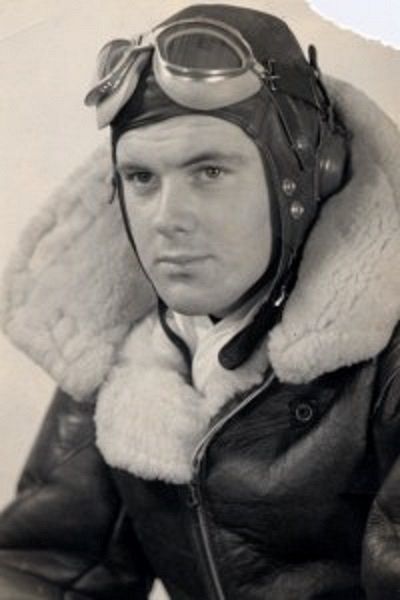
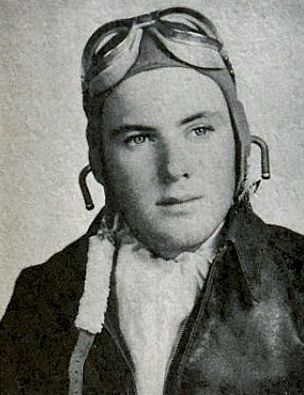
Photo source: Randy Foster, Arie-Jan van Hees - PIlot 43-A Gibbs Field Texas