
Missing information?
Do you have any additional information you would like to share about a soldier?
Submit- Full
name
EDWARDS, Buford N - Date of
birth
9 February 1920 -
Age
23 - Place of
birth
Kansas -
Hometown
Jackson County, Kansas
Personal info
Military service
- Service
number
18193495 -
Rank
Sergeant -
Function
Ball Turret Gunner -
Unit
410th Bombardment Squadron,
94th Bombardment Group, Heavy
-
Awards
Purple Heart,
Air Medal
Death
-
Status
Finding of Death - Date of
death
29 November 1943 - Place of
death
North Sea, about 45 miles east off the English coast
Grave
-
Cemetery
American War Cemetery Margraten - Walls of the Missing
Immediate family
-
Members
Albert M. Edwards (father)
Edna C. (Fink) Edwards (mother)
Kenneth M. Edwards (brother)
Helen L. Edwards (sister)
Waneva P. Edwards (sister)
Cecil L. Edwards (brother)
Ruth N. Edwards (sister)
Herbert A. Edwards (brother)
Lila C. Edwards (sister)
Mary V. Edwards (sister)
Plane data
- Serial
number
42-23352 -
Data
Type: B-17F
Nickname: Virgins Delight
Destination: Bremen, Germany
Mission: Bombing of the port
MACR: 1176
More information
Sgt Buford N. Edwards was a blacksmith.He volunteered for the Army of the United States in Oklahoma City, Oklahoma on 20 November 1942.
Of the ten crew members, only the pilot 2nd Let Walter Chyle Jr. survived. After the war, he recalled what happened during that tragic flight. The airplane was hit by flak in the n° 4 engine over the target, a few seconds after it dropped his bombs without anyone wounded. The pilot took the plane out of the formation, dropped to tree top level and led seven German fighter planes on a "hedge-hopping" chase over Germany and Holland toward the North Sea.
Two of the German fighters were shot down, and the other five gave up about 20 miles out to sea.
However, it was becoming more and more apparent to the crew that their plane would not have enough fuel to make it back to an air base in England, but they flew on, maintaining radio contact with England. And they kept talking, so they could get a fix on their location.
Eventually the n° 3 engine quit, and shortly thereafter n° 1 engine began to sputter. As the plane neared stall speed, Lt Chyle was advised by radio that he should ditch the aircraft. They said, “You’re 45 miles from the coast and we’ll be out there to get you in a little while.”
About 4 p.m. the 10 men crew evacuated the plane safely and set adrift in rubber life boats tied together, (5 men in each raft) minutes before the bomber sank in the icy waters of the North Sea.
As the men waited for help a tremendous storm blew up with monstrous waves that tossed the rafts into the air, capsizing them numerous times, dumping all their emergency provisions, and carrying their rafts a considerable distance from where the plane had been ditched. Although no one drowned during the storm, within 4 hours one crewman, who was sitting next to Chyle in chest-deep water inside the raft, began to nod forward as if dozing off, and a few minutes later was dead from the effects of the cold. The miserable night passed with only brief conversations, and fog was so dense the next morning that Lt Chyle could not see the second raft, trailing his own by 30 to 40 feet. Two more of the crewmen aboard his raft had frozen to death during the night, and when the second raft was pulled along the first, all five of its occupants were dead. At that time only the Lt Chyle and the Bombardier, Lt Maximowicz, were left alive.
Airplane engines roared overhead, looking for the lost crew, but, alas, the fog was so thick that the two desperate survivors could not be seen from the air, and their flares had been lost during the storm.
Finally, the planes were heard no longer. Chyle and the bombardier decided to cut the second raft loose from their own, which was starting to show signs of wear, and to put the three bodies in their raft overboard.
Two hours later Lt Maximowicz died. After another 24 hours Lt Chyle was found by a German patrol boat off the coast of Holland, and transferred to a hospital, where he was examined extensively by German doctors. After this he was eventually sent to a prisoner of war camp.

Source of information: Raf Dyckmans, NARA, WWIIMemorial.com, ArmyAirForce.com, www.findagrave.com
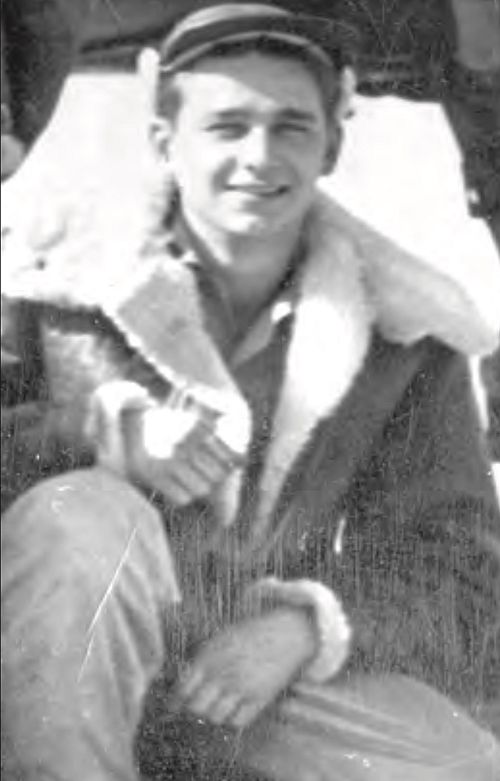
Photo source: Tena Brucken (DAR Jackson County, Kansas) and Emily Jane Stoll (DAR Jackson County, Kansas) and Sherrie Smith (DAR Hays, Kansas)