
Missing information?
Do you have any additional information you would like to share about a soldier?
Submit- Full
name
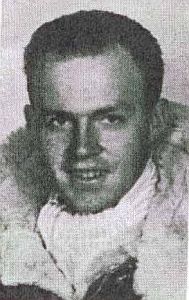
SORENSEN, Gerald E - Date of
birth
31 October 1919 -
Age
24 -
Place of birth
Blackfoot, Bingham County, Idaho -
Hometown
Bannock County, Idaho
Personal info
Military service
- Service
number
19095816 -
Rank
Staff Sergeant -
Function
Armorer/Tail Gunner -
Unit
339th Bombardment Squadron,
96th Bombardment Group, Heavy
-
Awards
unknown
Death
-
Status
Killed in Action - Date of
death
3 September 1944 - Place of
death
Marc-Les-Engheim, Belgium
Grave
-
Cemetery
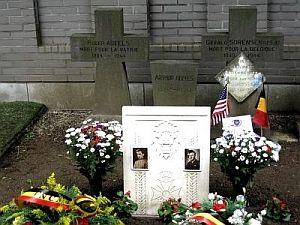
Ganshoren's cemetery, Belgium
| Plot | Row | Grave |
|---|---|---|
Immediate family
-
Members
Ephraim Sorensen (father)
Luella Sorensen (mother)
Nora L. (Lewis) Sorensen (wife)
Plane data
- Serial
number
42-31152 -
Data
Type: B-17G
Destination: Mertz, France
Mision: Combat
MACR: 4237
Biography
AOMDAMore information
Gerald E. Sorensen entered the Service in May of 1942. His plane crashed on 1 May 1944 and he was Killed in Action several months later while cooperating with the Belgium resistance.S/Sgt Sorensen was waist gunner in a Flying Fortress. He was a quiet youth of 24 who didn't talk much about the 28 missions he had fown over enemy territory. The only time he found any enthusiasm for talking was when he discussed with his shipmates the end of his tour of operations, he had three more to go, and then perhaps a furlough back to Pocatello. Around the station they always regarded Jerry as a strange character. He didn't drink or use cuss words; he was deeply religious. And he was a first-class waist gunner.
Jerry's ship "caught it" on the twenty-ninth mission. The fort was rocked by flak all the way from Berlin to Dusseldorf on the return journey and somewhere over Belgium the men bailed out. Jerry dropped into a thick forest and found himself alone. He wandered for two days living on chocolate and bezedrine, until he was picked up by a patrol of Belgium's "Armee Blanche," the secret force of young patriots sworn to the destruction of the German oppressor. In the patrol was a 20-year-old youth named Roger Abeels. Jerry spoke nothing but English; Roger knew only French and Flemish. But they liked each other the moment they met and when the patrol crawled out of the woods under cover of darkness, Roger took Jerry to his home on the outskirts of Enghien. For two months Jerry hid in the Abeels household. Roger's civilian clothes fitted him well, and Roger's father, mother and sister grew to look upon Jerry as their second son and brother. The summer sped by and Jerry had become a member of the family and roger's inseparable companion. Each night the family gathered in the cellar to hear the British radio, and they trace the approach of the British armies toward Brussels with breathless enthusiasm. Then came Saturday, September 2. After dark that evening a messenger from the "Armee Blanche" dashed into the house with great news. British tanks were that night leaving Tournai, on the French-Belgian border and heading straight for Brussels. After four years liberation was almost at hand! Roger was ordered to report to his company headquarters in the wood at 6 o'clock the next morning. At 5 the next morning the entire household was awake. Roger came downstairs in his white coverall, his secret uniform with an armband of black, red and gold. Jerry wore his leather flying jacket and his Colt hung from his pistol belt. He was determined to fight together with Roger.
Early that afternoon, September 3, a column of British tanks, rolling some six miles southwest of Enghien, was halted by a German battle group of Tiger tanks and infantry covering the highway. As the action began for possession of the highway, the Germans found themselves attacked from the rear by a company of belgian irregulars. The battle was short and fierce. Within half an hour, the British tanks had smashed through and were racing toward Brussels. The next day a British division mopping up on the flanks discovered a cluster of German and Belgian bodies in a wood off the highway. Lying side by side were Roger Abeels and Jerry Sorensen. They were buried side by side and at the head of their graves were places crossed flags of the United States and Belgium.
Source of information: FOHF, AOMDA, National Archives / WWII Memorial, www.newspapers.com - The Pittsburgh Press
Photo source: AOMDA