
Missing information?
Do you have any additional information you would like to share about a soldier?
Submit- Full
name
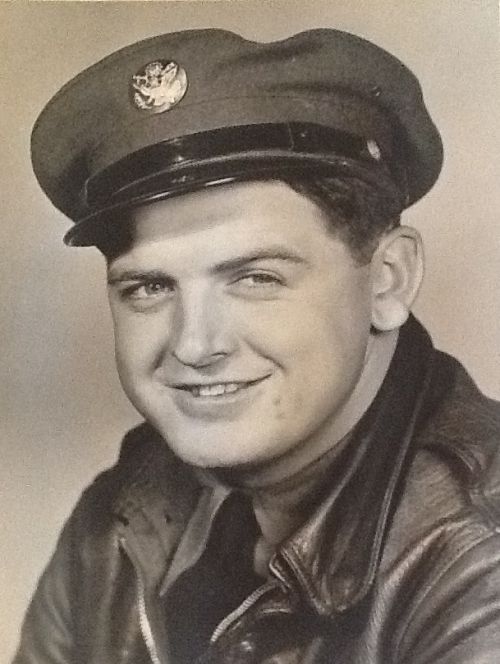
ZENZ, George R "Bob" - Date of
birth
27 January 1920 -
Age
25 -
Place of birth
Green Bay, Brown County, Wisconsin -
Hometown
Green Bay, Brown County, Wisconsin
Personal info
Military service
- Service
number
16005531 -
Rank
Technical Sergeant -
Function
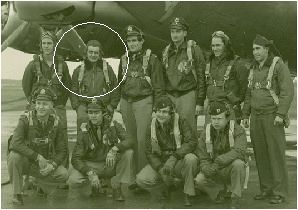
Waist Gunner -
Unit
324th Bombardment Squadron,
91st Bombardment Group, Heavy
-
Awards
Distinguished Flying Cross with Oak Leaf Cluster,
Silver Star,
Purple Heart,
Air Medal with 9 Oak Leaf Clusters
Death
-
Status
Missing in Action - Date of
death
3 February 1945 - Place of
death
Bellevue Allee, Tiergarten Zoo
Berlin, Germany
Grave
-
Cemetery
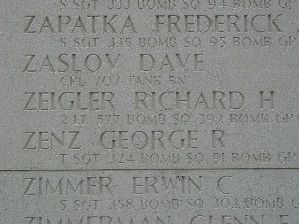
American War Cemetery Margraten - Walls of the Missing
Immediate family
-
Members
George Zenz (father)
Minola (Carey) Zenz (mother)
James Zenz (brother)
Plane data
- Serial
number
42-97632 -
Data
Type: B-17G
Destination: Berlin, Germany
Mission: Bombing of the Tempelhof marshalling yard
MACR: 12232
More information
T/Sgt George R. Zenz joined the infantry of the Regular Army in Milwaukee, Wisconsin on 7 August 1940.He was sent to Camp Ord, California for infantry training. On 10 July 1941 he was transferred to the Air Corps and received training at Fort Douglas, Utah, Alexandria, Louisiana and Scott Field, Illinois. He left the United States for overseas service from San Francisco on 21 November 1941 and arrived in Brisbane, Australia. In December 1942 he returned to the U.S after flying 48 missions in the Pacific. On 26 October 1943, he again left for overseas service from New York and arrived at Grenock, Scotland on 2 November 1943.
He participated in the Coral Sea Battle, Solomons Battle and in the Java, Australian, New Guinea, Normandy, Northern France and Rhineland Campaigns. He participated in several heavy bombardment missions in France and Germany. T/Sgt Senz was reported missing in Action 3 February 1945 while on an operational mission near Berlin, Germany and was presumed dead 4 February 1946. It was his 58th mission in Europe.
The plane was flying as leader of the group.
Statement of 2nd Lt. Merlin M. Goldberg:
"I was flying as pilot in no. 2 position of the 4th element, and at about ten seconds after bombs away I observed an explosion of a direct flak hit in the waist section of aircraft B-17G 42-97632. At this time I also saw what appeared to be a secondary explosion in the interior of the aircraft as fire shot out of the nose. The aircraft disintegrated from about the horizontal stabilizer to the trailing edge of the wing. The tail section floated back through the formation and the forward section nosed downward. No flames or smoke were visable. I saw no crew members leave the aircraft or parachutes open."
The entire crew was killed. The remains were taken to the Reserve Hospital 101, Olympia Village at Döberitz. They were initially buried at the POW Cemetery at Elsgrund-Döbertiz.
In June 1951 an investigation was conducted to find several American deceased at the grounds where the POW Cemetery of Döbertiz was situated. The former caretaker, however, stated that the Americans exhumed their remains in 1947, in 1948 the French and in 1949 the Italians, Germans and Russians completely exhumed the cemetery. This was done systematically, field by field, row by row. In late 1949 the former cemetery site was returned to its German owner. In 1951 it was planted with potatoes. The conclusion of the investigation was that when the cemetery finally was disinterred all remains left, were evacuated to Russian or German Honor cemeteries and buried in unmarked graves.
Source of information: Raf Dyckmans, Peter Schouteten, Vince Schiebel (nephew), www.91stbombgroup.com, www.wwiimemorial.com, www.archives.gov - Headstone and Interment Record, www.fold3.com - MACR, IDPF of Herald R. Boyd
Photo source: Peter Schouteten, Frenk Lahaye, Vince Schiebel