
Missing information?
Do you have any additional information you would like to share about a soldier?
Submit- Full
name
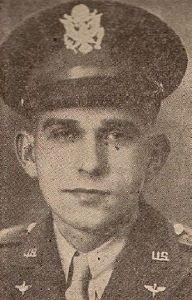
HAWLEY, William Russell - Date of
birth
2 August 1920 -
Age
23 -
Place of birth
Swan Creek, Saginaw County, Michigan -
Hometown
Saginaw, Saginaw County, Michigan
Personal info
Military service
- Service
number
O-695905 -
Rank
Second Lieutenant -
Function
Navigator -
Unit
751st Bombardment Squadron,
457th Bombardment Group, Heavy
-
Awards
Purple Heart,
Air Medal with Oak Leaf Cluster
Death
-
Status
Missing in Action - Date of
death
28 May 1944 - Place of
death
The English Channel, 25 miles west of Ostende, Belgium
Grave
-
Cemetery
American War Cemetery Ardennes - Tablets of the Missing
Immediate family
-
Members
Lloyd Hawley (father)
Lila (Warner) Hawley (mother)
Russell Hawley (brother)
Jack Hawley (brother)
Margaret L. (Dye) Hawley (wife)
Plane data
- Serial
number
42-97452 -
Data
Type: B-17G
Destination: Dessau, Germany
Mission: Bombing of the oil refinery
MACR: 5294
More information
2nd Lt William R. Hawley was a shipping clerk. He joined the Air Corps of the U.S. Army Reserve in Detroit, Michigan on 10 August 1942.Statement of Jack Gumm:
“Hauf was flying just above us. They got a direct hit in the right wing tank and the gasoline caught fire. The B-17 had neoprene lined gas tanks. If one was punctured, it was supposed to reseal itself. The shell that hit Hauf’s plane exploded in the tank and made a hole too big to seal. At first there was quite a large flame and then the seal partially closed the hole, and the burning slowed.
From our position in the formation I had a good view on the burning tank. We were at 22,000 feet, and, in the rarified air, the gas didn’t burn too well. Hauf and Swain talked to me and my first pilot about whether to bail out or not and we discussed the best course of action. Hauf had his crew on alert to bail out over Germany but decided to stick with the formation. When we were close to the Belgian coast, our formation started to descend to 15,000 feet over the Channel. The fire in the tank immediately increased, and we told Hauf. He decided not to bail out until he reached England.
About 40 K’s from the English coast, the wing gave way and folded back. The B-17 went into a rapid flat spin. The centrifugal force was probably too great for the crew to bail out. We pulled out of formation and followed the plane all the way to the surface of the Channel. It sank immediately and no bodies were seen. We circled the area about five minutes, but no bodies came to the surface. …”
Statement of 1st Lt. G. B. Poore:
"The airplane made it to Leipzig undamaged. On the bomb run and turning away from the secondary target, we encountered moderate flak. Lt. Hauf's plane was seen to receive a near burst of flak which left his right wing on fire between the #4 engine and the wing tip. The fire soon went out and he was able to stay in formation. The damage to the wing was very noticeable to us as it was on the leading edge of the wing and on top. From Leipzig to Brussels, the fire was seen to smoulder at times. One body was seen leave the airplane after the flak burst. At Brussels, Lt. Hauf was seen to start lagging behind the formation and start to lose altitude. The airplane was going to a lower altitude very rapidly and the fire seemed to spread across the wing and fuselage. The right wing broke away and the ship went into a violent spin and blew up before hitting the water."
The entire crew of nine was killed and are still listed as Missing in Action. Six of them are remembered at the Tablets of the Missing at Ardennes Cemetery. Three of them are remembered at the Walls of the Missing at Cambridge Cemetery.
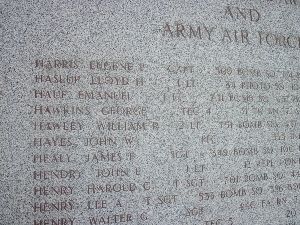
Source of information: Raf Dyckmans, Terry Hirsch, Archives.gov, Enlistment Record, Fold3.com, MACR, WWII Draft Card, 1930 US Census
Photo source: Jac Engels, Homepage - The 457th Bomb Group (H) Association (457thbombgroupassoc.org)