
Missing information?
Do you have any additional information you would like to share about a soldier?
Submit- Full
name
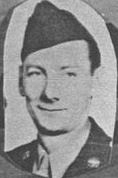
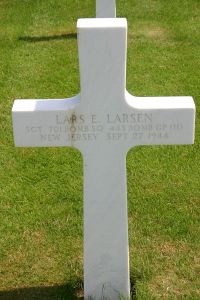
LARSEN, Lars Edward "Babe" - Date of
birth
6 January 1913 -
Age
31 -
Place of birth
New York -
Hometown
Mountain View, Mercer County, New Jersey
Personal info
Military service
- Service
number
32778375 -
Rank
Sergeant -
Function
Top Turret Gunner -
Unit
701st Bombardment Squadron,
445th Bombardment Group, Heavy
-
Awards
Purple Heart,
Air Medal
Death
-
Status
Killed in Action - Date of
death
27 September 1944 - Place of
death
Near Polch, Germany
Grave
-
Cemetery
American War Cemetery Margraten
| Plot | Row | Grave |
|---|---|---|
| A | 5 | 24 |
Immediate family
-
Members
Erik Larsen (father)
Caroline G. (Korst) Larsen (mother)
Hilda M. Larsen (sister)
Erick Larsen (brother)
Louise A. Larsen (sister)
Harold F. Larsen (brother)
Elizabeth M. Larsen (sister)
Helen H. (Ralston) Larsen (wife)
Plane data
- Serial
number
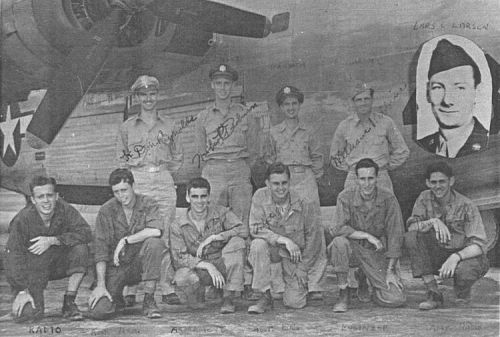
42-30579 -
Data
Type: B-24J
Nickname: Little Audrey
Destination: Kassel, Germany
Mission: Bombing of the Henschel aviation industry
MACR: 9761
More information
Sgt Lars E. Larsen was employed by the Wright Aeronautical Corporation of Paterson.Moments after the tail gunner, Harry G.Twigg, shouted into the interphone, “Fighters, six o’clock”, exploding shells were hitting the plane while others exploded in close proximity.
The left inboard engine spewed flames reaching back to the left rudder. There was a fire inside the plane on the command deck, over the bomb bays. The oxygen and hydraulic systems were shot out, as were our radio and intercom. The right rudder was flapping wildly as it clung to the stabilizer by the middle hinge. The upper surfaces of the wings and fuselage were riddled with bullet and shell holes. The top of the tail turret was open like a tin can. Two feet of wing and flap were missing from engine number two.
The attack was over in about five minutes. At that moment, ‘Little Audrey’ was alone. The pilots were working to shut down engine number two. It would not feather. The fuel valve was closed off, and the fire died out. Twigg, the tail gunner, was wounded in several places and put out a small fire. The waist gunners were severely wounded. There was a strong odor of gasoline on the flight deck. The bomb bay doors were opened to reduce the hazard.
After losing some altitude, the oxygen system was down, with diminishing power, and they flew westward, hoping they might reach an area held by advancing Allied forces. About fifteen minutes after the attack ended, a single-engine fighter came upon their rear. The pilot changed course and showed his AAF insignia. It was a P-51. He came abreast the left side and motioned to his ear phone, but the B-24's radio was down. As there was nothing he could do, he departed.
When they crossed the Rhine River at about 800 feet, they encountered 20 mm ground fire. The pilot, Donald N. Reynolds, dropped lower to escape the fire - to no avail. To prepare for the crash, the crew took their ditching positions. Shells were hitting almost until it crash-landed. The point of landing was near the railway station in Polich, at about noon, local time.
Badly damaged the airplane crash-landed in the vicinity of Polch, 30 km west of Koblenz.
Within a few minutes, armed soldiers arrived by truck. They sought to make an opening to the flight deck to permit several men to get free from the wreck. In the rear, the waist gunner, Lars Larsen, was dead, probably hit by small arms fire when the plane was at low altitude.
Seven crew members survived, of whom some were badly wounded. They were taken prisoner. Besides Sgt Larsen, Sgt Robert M. Long, the nose turret gunner, didn't survive. He died in a hospital in Bendorf.
Source of information: Peter Schouteten, Raf Dyckmans, www.wwiimemorial.com, www.ancestry.com - Family Tree
Photo source: Peter Schouteten, Anthony L. Destro