Missing information?

Do you have any additional information you would like to share about a soldier?

Submit

Personal info

Full name
VICKERS, Frank Sulva
Date of birth
20 December 1925
Age
19
Place of birth
Fauquier County, Virginia
Hometown
Fauquier County, Virginia

Military service

Service number
11128297
Rank
Staff Sergeant
Function
Waist Gunner
Unit
702nd Bombardment Squadron,
445th Bombardment Group, Heavy
Awards
Purple Heart,
Air Medal with 3 Oak Leaf Clusters

Death

Status
Killed in Action
Date of death
7 April 1945
Place of death
15 Miles South of Bremen, Germany

Grave

Cemetery
American War Cemetery Ardennes
Plot Row Grave
D 21 21

Immediate family

Members
Reginald J. Vickers (father)
Helen B. Vickers (mother)
Reginald J. Vickers Jr. (brother)
Lucy V. Vickers (sister)

Plane data

Serial number
42-94870
Data
Type: B-24H
Nickname: Axis Ex-Lax
Destination: Duneberg, Germany
MACR: 13894

More information

S/Sgt Frank S. Vickers enlisted at Fort Devens, Massachusetts on 14 February 1944.

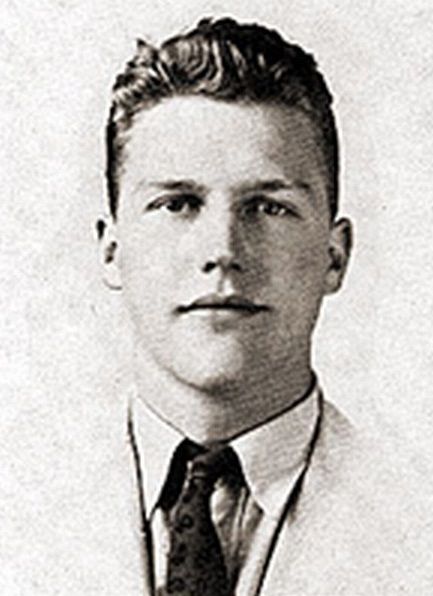
Frank Vickers entered the Second Form in 1939. In his Fifth Form year he rowed No. 2 on the Halcyon crew and the following autumn he played in the line of the Delphian football team and won his S.P.S. His good humor and his soundness of judgment cused him to be greatly liked and respected. He was Secretary of the Missionary Society, a Supervisor in a Third Form house and a member of the council. Having volunteered for service in the Air Force at Manchesterr, N.H. in June, 1943, he studied at the Exeter Summer School, graduated from St. Paul's in January, 1944, and was admitted to Harvard. Called to active duty in February, he received gunnery training at Harlingen Field, Texas, and was assigned to a B-24, and after combat crew training at Westover Field, Massachusetts, he went overseas in late September 1944.

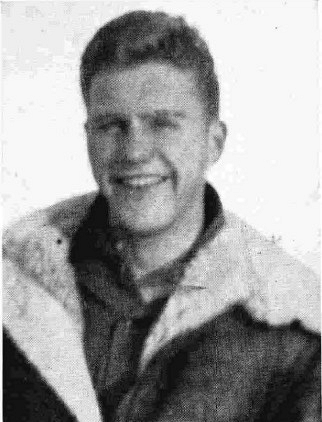
In England, he was assigned to the Eight Air Force, Second Air Division, 445th Bomb Group (H), 702nd Bomb Squadron, based at Tibenham near the coast of Norfolk in East Anglia. He was a ball gunner at first, because no other gunner in his crew could squeeze into that turret. Later, when the Sperry ball was removed from the Liberator, he was a waist gunner. On the return trip from their first mission, Vickers and the rest of his crew narrowly escaped death when their B-24 crash landed in Belgium. They sold the silk of their parachutes on the streets of Brussels for food and were three weeks getting back to their base.

During the winter of 1944 they survived a second crash-landing. In the spring began the wave of saturation bombing that spread over every part of Germany. In one five-day period they took part in four long missions, to Berlin on the north and to targets on the Danube in the south. Late in March they were bombing nearer targets, munitions centers and railheads on the westerrn fringe of Germany, in support of the drive across the Rhine.

Vickers wrote home: "I'm sending a copy of the Stars and Stripes which has quite a write-up on the airborne landings in Germany. If you will read closely you will see some mention of the Liberators who usually take back seat in news compared to the Forts. For once the old Libs were right there carrying the ball." After that, the crew was sent to a Rest Home for a week.

They took off again the morning after their return. "It was the most beautiful spring day you ever saw", wrote the nose gunner, 'not a cloud. At 22,000 feet we were flying the left element of the lead squadron and the last ship on that wing. The bullets from the Jet who got us, coming up from behind, racked through our ship from the tail clear through the bomb bay, hit the tail gunner, killed both waist gunners instantly and started a fire in the gas tank. In a few seconds the ship went out of control and exploded. The concussion blew the men free, their parachutes opened and they floated down...." From another plane, a friend of Vickers' - also in the Form of '44 at the School - seeing the attack and the parachutes opening, thought the men had been saved. But only the nose and tail gunners were alive. Frank's body was found near the wreckage of the plane. He had completed many missions and had almost finished his tour of duty when, at the age of nineteen, he was killed in action over Germany, April 7, 1945.

"Ship 870 was attacked by an ME-262 and a fire was started in the bomb bay. The ship started to go down and all crew members put on their parachutes. The ship exploded and six men were blown clear of the plane. Frank S. Vickers was found near the wreckage of the plane."

S/Sgt Frank S. Vickers was first buried at Temporary American Military Cemetery Neuville-en-Condroz Block I, Row 3, Grave 64.

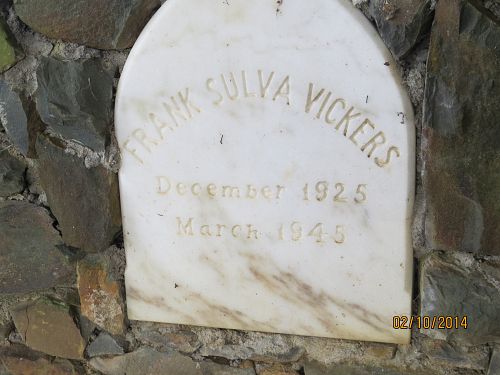
He is remembered at Vickers Cemetery in The Plains, Fauquier County, Virginia with a memorial marker.

Source of information: Peter Schouteten, Terry Hirsch, Ross Whistler, Erwin Derhaag, www.wwiimemorial.com, www.archives.gov - WWII Enlistment Record, www.ancestry.com - U.S., Headstone and Interment Records for U.S. Military Cemeteries on Foreign Soil / 1930/1940 Census, http://www.americanairmuseum.com/aircraft/9885, Virginia Birth Index

Photo source: Peter Schouteten, Alumni Horae St. Pauls School - April 1944, www.findagrave.com