
Missing information?
Do you have any additional information you would like to share about a soldier?
Submit- Full
name
PORTER, Robert L - Date of
birth
9 June 1920 -
Age
23 -
Place of birth
Chicago, Cook County, Illinois -
Hometown
Cook County, Illinois
Personal info
Military service
- Service
number
O-688779 -
Rank
Second Lieutenant -
Function
Navigator -
Unit
703rd Bombardment Squadron,
445th Bombardment Group, Heavy
-
Awards
Purple Heart,
Air Medal with Oak Leaf Cluster
Death
-
Status
Killed in Action - Date of
death
24 February 1944 - Place of
death
Leimbach, west of Bad Salzungen, Germany
Grave
-
Cemetery
American War Cemetery Henri-Chapelle -
Tablets of the Missing
* This soldier has been accounted for. A rosette has been placed next to his name.
Immediate family
-
Members
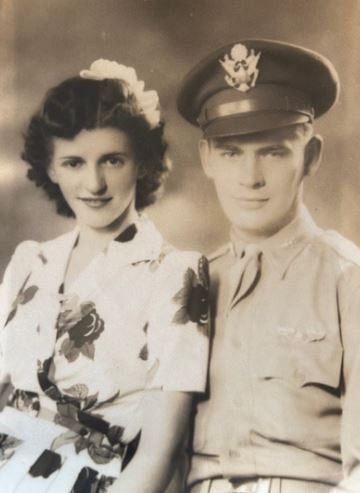
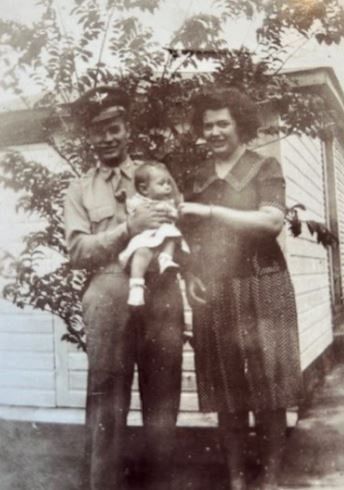
Ethel Porter (wife)
Plane data
- Serial
number
42-100312 -
Data
Type: B-24J
Destination: Gotha, Germany
Mission: Bombing of the Gothaer Waggonfabrik, aviation industry
MACR: 2560
More information
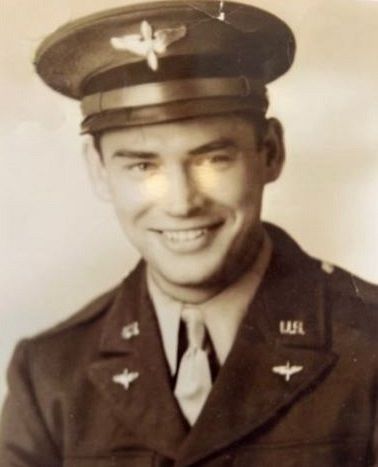
2nd Lt Robert L. Porter worked in the printing and publishing business.He volunteered for the Air Corps of the Army of the United States in Chicago, Illinois on 26 March 1942.
Statement of surviving crew member, Leroy E. Dunster: "We were attacked by German fighter planes (Fw-190s) just after we passed over the Zuyder Zee and were under continuous attack from there until the time our ship was put completely out of commission. We suffered a few hits early in the attack, but I don't believe anyone was wounded. A piece was blown out of the top of the turret, but the bombardier, who was flying that position, said he was not hit. We then went through a flak area, over Eisenach, I think it was, and received a few more minor hits. Immediately after the flak, we had another fighter attack. This time by JU-88s. In this attack, a shell burst just outside the flight deck and caused me to receive wounds in both hands and one leg. I am sure that up until this time no one had been hit on our ship, and since I didn't have time to report my wounds to the pilot, I heard none of the others mention any either. After I opened the bomb bays and watched the bomb strike and closed the doors again, I returned to my radio to pick up the Bomb Strike Message. About this time, we received a direct hit in our No. 3 engine, which tore it completely off the wing. We immediately lost altitude, and the pilot gave the order to bail out. I opened the bomb bays again and prepared to jump, as did the others who were on the flight deck. This includes the Engineer, Pilot and Co-pilot. As the pilot and co-pilot climbed out of their seats, we must have gone into a spin, and I was unable to move at all. Both pilot and co-pilot returned to their stations and took the controls. Sgt Banta, the Engineer, was standing at the bomb bays with me and, as I thought, would jump with me. I was suddenly thrown out through the open bays and saw nothing more of anyone on the airplane.
"The plane seemed to be in a steep dive and perhaps turned over in the air, and there was a terrific force in play that prevented me from moving. I did hear a terrific loud explosion a few seconds after being thrown from the plane."
Seven crew members were killed, and two survived and were taken prisoner.
After the crash, German troops recovered the remains of the ball turret gunner and buried them in a local cemetery. The other six crewmembers, including Coy, were unaccounted for following the war.
In March 1952, the American Graves Registration Command (AGRC), the organization that searched for and recovered fallen American personnel in the European Theatre, took custody of comingled unidentified remains recovered from Bad Salzungen Cemetery. These remains, X-9093 Griesheim Mausoleum (X-9093), X-9094 Griesheim Mausoleum (X-9094), and X-9095 Griesheim Mausoleum (X-9095), were believed to be those belonging to S/Sgt Coy’s downed aircraft. At the time, identification of these remains was not possible, and they were interred in the Ardennes American Cemetery.
In June 2021, DPAA historians and American Battle Monuments Commission personnel exhumed X-9093, X-9094, and X-9095 from Ardennes American Cemetery and transferred them to the DPAA Laboratory for analysis and identification.
To identify Porter’s remains, scientists from DPAA used anthropological analysis. Additionally, scientists from the Armed Forces Medical Examiner System used mitochondrial DNA (mtDNA) analysis.
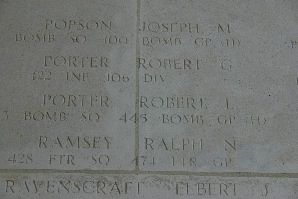
Porter’s name is recorded on the Tablets of the Missing at Henri-Chapelle American Cemetery. A rosette is placed next to his name to indicate he has been accounted for.
2nd Lt. Porter will be buried in Elmwood, Illinois, on a date to be determined (information added March 2024).
Source of information: Raf Dyckmans, Peter Schouteten, Terry Hirsch, www.wwiimemorial.com, www.archives.gov, www.fold3.com - MACR
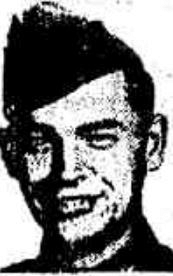
Photo source: Peter Schouteten, Chicago Tribune - 14 April 1944