
Missing information?
Do you have any additional information you would like to share about a soldier?
Submit- Full
name
TAYLOR, Lee A - Date of
birth
5 September 1917 -
Age
27 -
Place of birth
West Virginia -
Hometown
Holden, Logan County, West Virginia
Personal info
Military service
- Service
number
35772070 -
Rank
Staff Sergeant -
Function
Left Waist Gunner -
Unit
854th Bombardment Squadron,
491st Bombardment Group, Heavy
-
Awards
Purple Heart,
Air Medal with Oak Leaf Cluster
Death
-
Status
Killed in Action - Date of
death
26 November 1944 - Place of
death
On the roof of tobacco factory Vander Elst, Arnould Nobelstraat
Leuven, Belgium
Grave
-
Cemetery
American War Cemetery Henri-Chapelle
| Plot | Row | Grave |
|---|---|---|
| G | 4 | 70 |
Immediate family
-
Members
John M. Taylor (father)
Irene S. Taylor (mother)
Margaret I. Taylor (sister)
Mable V. (Lyle) Taylor (wife)
Plane data
- Serial
number
42-50610 -
Data
Type: B-24
Nickname: Reluctant Dragon
Destination: Misburg, Germany
Mission: Bombing of the Deurag-Nerag oil refinery
More information
S/Sgt Lee A. Taylor's mother died in 1932 and he was raised by an uncle and aunt with whom he remained until he entered military service.He was a general superintendent of the Island Creek Coal Co before he enlisted in Huntington, West Virginia on 10 August 1943.
The squadron mistakenly dropped their bombs in an open field when the formation was attacked by German fighters. Due to a technical defect, this aircraft even dropped its load through the bomb hatches, leaving remnants of these hatches dangling at the bottom of the aircraft. As a result, three German fighter pilots realized that this aircraft could be in trouble and they focused their attention specifically on this aircraft. Their attacks resulted in the shutdown of engines 3 and 4. In addition, engine 2 was running at 75% of its power due to the loss of the turbo. The right tailplane was also unusable.
One of the attackers was probably shot by the gunners and another damaged, causing the attack to be aborted.
The plane was losing more and more altitude and needed another hour to reach friendly territory. The fuel level was dropping and the fuel lines had been cut making it impossible to refill from the auxiliary fuel tanks. However, the pilot absolutely wanted to make an emergency landing because both flank gunners were seriously injured. Waist gunner Otto Carbone saw Taylor being hit and putting his hands in the air as if signaling 'no more' and he fell to the bottom of the plane. Taylor was wounded in the abdomen and buttocks by a 20mm explosive shell.
The testimonies of the pilots show that at a certain point an emergency landing had to be avoided. The pilot had difficulty keeping the aircraft under control any longer. He decided that it would not be wise to attempt a landing with an aircraft that was so seriously damaged and therefore ordered the aircraft to be abandoned. The two injured men are prepared for their jump and their parachutes were clipped to the harness. Bombardier Lt. Henry J. Latimore Jr. realized that Taylor was unable to open his parachute by himself by pulling the release ring (handle used to open the parachute) and connected the ring to a cord to ensure that his parachute would open automatically once he fell out of the plane. Taylor was the first to leave the plane via the bottom hatch at the back of the aircraft. The parachute opened successfully, but his body position relaxed. Taylor probably died on the way to Earth.
Lee Taylor landed on the roof of the Vander Elst tobacco factory in the Arnould Nobelstraat in Leuven, but the unfortunate man fell over the roof and got stuck against the facade.
Gilbert Organe a local citizen from Kessel-Lo witnesses the fall of Lee Taylor above Leuven: “He ended up on the roof of the Vander Elst tobacco factory in Arnould Nobelstraat. The parachute got stuck on some obstacle on the roof, and the unfortunate airman fell over the roof and ended up hanging against the facade by the cords of the parachute. He hung with his back against the facade of one of the buildings behind the tobacco factory and with his face towards Arnould Nobelstraat. We had the impression that he had already died before ending up on the roof."
Taylor had a bad feeling on the eve of the crash. He wanted to write a letter to his wife telling her not to buy the house they were planning to buy. When Carbone asked him why, Taylor said: “I don't think I'm going to make it back,” to which Carbone firmly replied: “They don't say something like that. Now think positive, don't forget I'm on the same plane with you!” He didn't write the letter that night.
On the afternoon of 27 November 1944, Lee Taylor was buried at Fosse Temporary American Military Cemetery. In 1948 he was reburied at Henri-Chapelle.
The crash is remembered with a memoral in Leefdaal, Belgium.
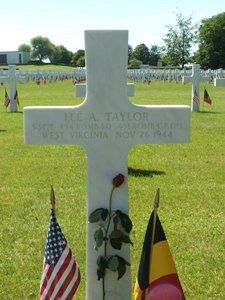
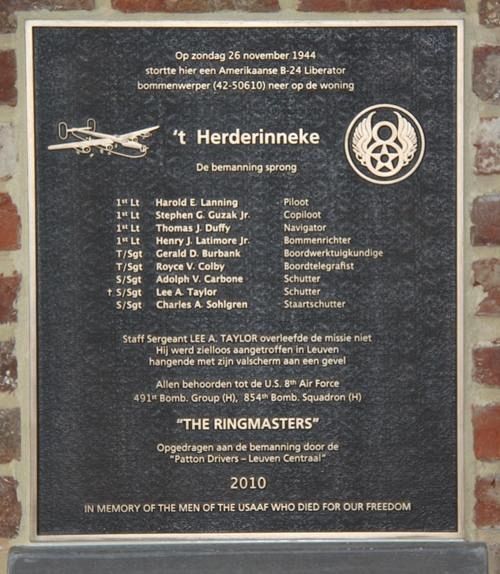
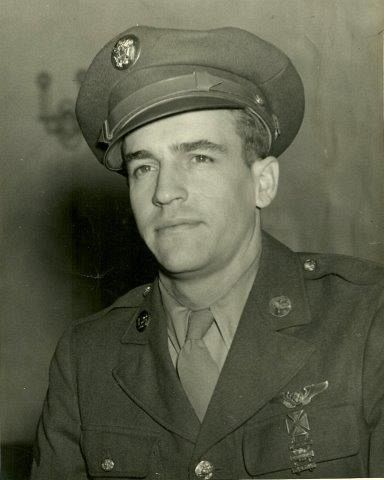
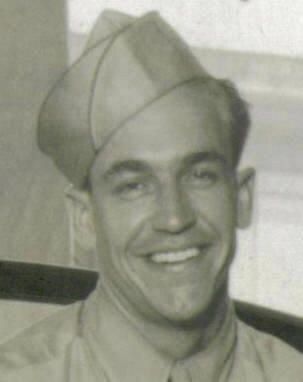
Source of information: Terry Hirsch, Raf Dyckmans, www.wwiimemorial.com, www.archives.gov, www.ancestry.com - 1930 Census / West Virginia Marriages, 1780-1970, West Virginia Memory Project / Headstone and Interment Record, Aviation Safety Network, https://heritageleague.org/armyairforces-com-forum-project/, http://www.leuvencentraal.com/crbst_26.html
Photo source: http://www.leuvencentraal.com/crbst_26.html, https://www.tracesofwar.com/, Alice Keefe (niece)