
Missing information?
Do you have any additional information you would like to share about a soldier?
Submit- Full
name
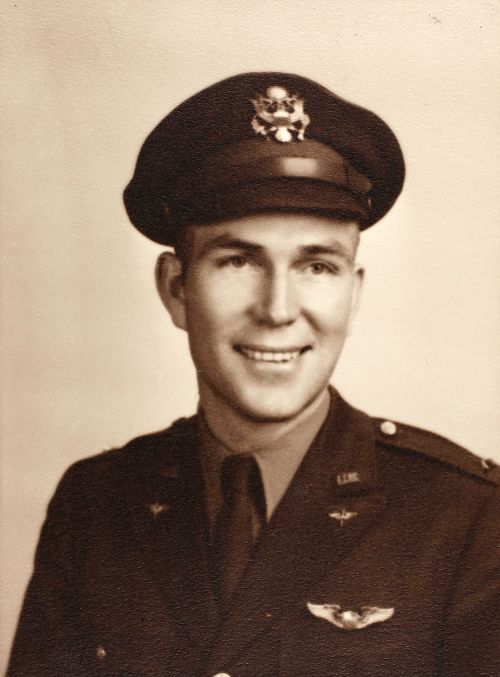
BROWN, James Wesley Jr - Date of
birth
16 August 1918 -
Age
25 -
Place of birth
Okmulgee, Okmulgee County, Oklahoma -
Hometown
Roswell, Chaves County, New Mexico
Personal info
Military service
- Service
number
O-754409 -
Rank
Second Lieutenant -
Function
Pilot -
Unit
547th Bombardment Squadron,
384th Bombardment Group, Heavy
-
Awards
Purple Heart,
Air Medal
Death
-
Status
Killed in Action - Date of
death
8 May 1944 - Place of
death
English Channel, 13 miles off the French Coast
Grave
-
Cemetery
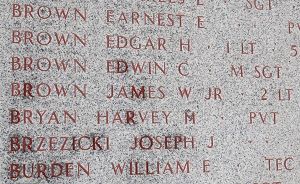
American War Cemetery Ardennes - Tablets of the Missing
Immediate family
-
Members
James W. Brown sr. (father)
Effie L. (Berryhill) Brown (mother)
Charlene Brown (sister)
Plane data
- Serial
number
42-97081 -
Data
Type: B-17G
Destination: Sottevast, France
Mission: Bombing of the V-2 launch site
MACR: 4812
More information
James W. Brown Jr. was 1/4 Native American of the Creek Tribe. He graduated from Hereford Central High School and attended Oklahoma University for one year.He was an oil well driller before he volunteered for the Air Corps of the Army of the United States at Fort Bliss, Texas, on 27 February 1941, and was sent overseas in March 1944.
Statement from S/Sgt George H. Yeager, Jr., S/Sgt, who was the tail gunner: "We saw flak before we crossed the enemy coast. The first airplane I noticed in trouble was the one ahead of us. It had been struck by flak, which blew off the plane's tail. The aircraft immediately went into a spin, and I don't believe anyone got out of it because I saw no parachutes. Shortly after the bomb run, flak struck our #4 engine and then #1 engine. Both engines cut out. The bombardier told us that #2 and #3 engines were working all right. #4 engine caught fire, but the fire went out in a short time. The next burst of flak that struck us hit the tail wheel, knocking it off. We were on the point of bailing out after the #4 engine caught fire, but it went out. We decided to try to make it back to the coast. Then the left wing was struck and almost torn from the aircraft. It was held on only by about 1-1/2 ft. of the leading edge and about 1 ft. of the trailing edge. The engineer then called and told us that there was a fire between #1 and #2 engines in the main gas tank. The interphone had been partially shot out, although some of us could hear. When we got down to 13,000 feet, the Pilot gave the order to bail out. We bailed out about 1905 hours. I was the seventh man to leave the airplane, the bombardier being the last man. Neither the Pilot nor Co-Pilot bailed out. When I got into the water, I had some difficulty getting rid of my parachute, as one side of it stuck. However, I finally got it off. I pulled the cords on my Mae West, and it inflated and then deflated. I began swimming around. The first explosion in the aircraft came when it was about 5/600 feet above the water. It went into a dive and then hit the water and sank. It came back up, and another explosion occurred, and it began burning, staying afloat for about 4 to 5 minutes. About 2045 hours, I was picked up by Air/Sea Rescue. I had seen none of the others after I landed in the water."
S/Sgt Yeager returned to his unit and began flying soon after. He was killed on a mission to Munich on 16 July 1944 and is buried at Ardennes Cemetery.
Two crew members survived and were rescued; eight men were killed.
2nd Lt James W. Brown Jr. is memorialized at South Park Cemetery in Roswell, New Mexico.
Source of information: Peter Schouteten, Raf Dyckmans, www.wwiimemorial.com, www.archives.gov, www.fold3.com, www.ancestry.com - Headstone Application for Military Veterans / New Mexico WWII Record
Photo source: FOHF, www.ancestry.com - New Mexico WWII Record