
Missing information?
Do you have any additional information you would like to share about a soldier?
Submit- Full
name
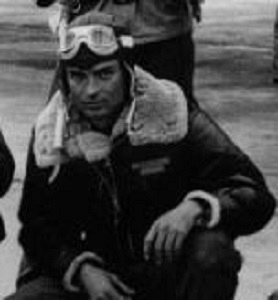
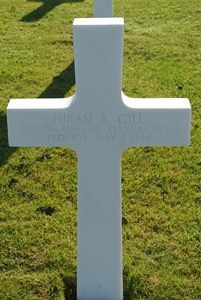
GILL, Hiram Angus - Date of
birth
7 January 1910 -
Age
34 -
Place of birth
Manatee County, Florida -
Hometown
Myakka City, Manatee County, Florida
Personal info
Military service
- Service
number
34531052 -
Rank
Sergeant -
Function
Left Waist Gunner -
Unit
734th Bombardment Squadron,
453rd Bombardment Group, Heavy
-
Awards
Purple Heart
Death
-
Status
Killed in Action - Date of
death
8 May 1944 - Place of
death
In the vicinity of Osterwieck-Feldmark, Germany
Grave
-
Cemetery
American War Cemetery Ardennes
| Plot | Row | Grave |
|---|---|---|
| A | 40 | 1 |
Immediate family
-
Members
Alfred C. Gill (father)
Ada F. (McLeod) Gill (mother)
Ola E. Gill (sister)
Alfred M. Gill (brother)
George H. Gill (brother)
Missouri M. Gill (sister)
Ada R. Gill (sister)
Verna R. Gill (sister)
Mavis L. Gill (sister)
Dorothy S. (Cowan) Gill (wife)
Mary Sue Gill (daughter)
Plane data
- Serial
number
42-52169 -
Data
Type: B-24H
Nickname: Lucky Penny
Destination: Brunswick, Germany
Mission: Bombing of the industrial area
MACR: 4594
More information
A German fighter attacked the B-24. The No. 2 engine caught fire and spread to all parts of the plane quickly. Sgt. Gill didn’t bail out. He was last seen in the waist with his parachute on, fighting fire. The aircraft crashed at 1020 hours in the vicinity of Feldmark, 5 km northwest of Osterwieck, 19 km northeast of Goslar. The aircraft exploded in the air and parts fell off, wreckage spread over 2 km.Statement from 2nd Lt. Thomas J. Stilbert Jr., Pilot:
"When I gave the order to bail out, Sgt. Angelle left the top turret, went down through the nose-wheel hatch. Sgt. Aratari left the nose turret and followed Lt. Syverson (navigator) and Lt. Botton (bombardier) through the nose-wheel hatch. Sgt. Urshansky, the radio operator, who had been trying to extinguish the bomb-bay fire, was helped through the top escape hatch by the co-pilot, Lt. Stephens who immediately followed.
A short time later the airplane exploded, breaking the tail section off in one piece. This allowed the tail gunner (John Dudash) to get out. He had previously been imprisoned in his turret by the intense heat of the flames.
As the airplane exploded, I was catapulted through the top of the airplane and thrown clear enough to open my parachute. Until I talked with the other members of the crew in prison camp at Dulag Luft, I had believed that the waist and ball turret gunners had also jumped safely. Some of them had seen the plane after the crash, but were not allowed to examine the wreckage for bodies. Their captors – German civilians and police, stated that there were three bodies still in the plane. They were then taken to Stötterlinger, the nearest village. I was captured at Kreiensen, after evading for about 24 hours.
Pvt John Dudash, tail gunner stated that he last saw Sgt Gill moving about in the flames between the waist and bomb-bay bulkhead, just prior to the explosion. Through conversations with other crew members, I concluded that Sgt Gill died wile helping Sgt Pessica in an attempt to get Sgt Acton out of the ball turret."
Sgt Hiram A. Gill was first buried at the cemetery of Feldmark on the evening of the same day as the crash, together with S/Sgt Pessica and an unknown body. This must have been Sgt Acton.
Source of information: Raf Dyckmans, www.abmc.gov, www.wwiimemorial.com, www.ancestry.com - U.S., Headstone and Interment Records for U.S. Military Cemeteries on Foreign Soil / Family Trees, www.fold3.com - MACR, www.b24bestweb.com
Photo source: Peter Schouteten, www.findagrave.com