
Missing information?
Do you have any additional information you would like to share about a soldier?
Submit- Full
name
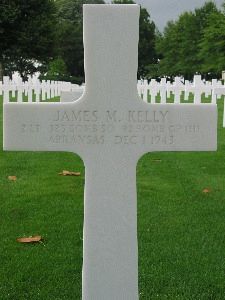
KELLY, James Maurice - Date of
birth
30 November 1920 -
Age
23 -
Place of birth
Eureka Springs, Carroll County, Arkansas -
Hometown
Eureka Springs, Carroll County, Arkansas
Personal info
Military service
- Service
number
O-676069 -
Rank
Second Lieutenant -
Function
Navigator -
Unit
325th Bombardment Squadron,
92nd Bombardment Group, Heavy
-
Awards
Purple Heart
Death
-
Status
Killed in Action - Date of
death
1 December 1943 - Place of
death
Near Elsig, northwest of Euskirchen, Germany
Grave
-
Cemetery
American War Cemetery Margraten
| Plot | Row | Grave |
|---|---|---|
| J | 2 | 12 |
Immediate family
-
Members
Marguerite L. Kelly (mother)
Plane data
- Serial
number
42-30803 -
Data
Type: B-17F
Nickname: Fame's Favored Few
Destination: Solingen and Leverkusen, Germany
Mission: Bombing of the industrial area
MACR: 1387
More information
The mission on 1 December 1943 was Frank C. Lockman's first mission and would also be his last. He was a replacement in Lt Hale's crew.The primary bombing targets were Solingen and Leverkusen, Germany. Records indicate that there was an equipment failure in the lead aircraft, which caused some diversion in the mission. The B-17s diverted to a secondary target to drop their bombs on Siegburg, Germany.
According to Sgt Wilson, the only surviving crew member, eight seconds before the designated target, the airplane took a direct impact of flak in the belly of the aircraft adjacent to the bomb bay. At impact, there was a very large explosion, and communications were immediately knocked out. Wilson thinks the explosion set off the incendiary bombs that were still locked in the bomb bay. Official records suggest that every aircraft dropped its bombs, and the flak explosion that damaged 42-30803 took place just after the target. Wilson is convinced that he heard a radio transmission that said the bombers were eight seconds from the target when the plane was hit; however, he admits that he could be wrong due to the fact that all squadron bombardiers drop their bombs as soon as they see the lead aircraft release its bombs.
Additional internal explosions caused smoke and fire to quickly engulf the mid-section and back half of the aircraft. Wilson said that when he first turned around to look forward through the B-17 to see what had happened, he noticed that the mid-section of the plane was in very bad shape and that more than likely the initial explosion killed the radio operator instantly. He commented that the wooden doorway that divides the radio control room from the mid-section of the aircraft (where the waist gunners are located) was riddled with existing flak holes. He also noticed that both waist gunner escape hatches were blown, and the gunners were no longer in the aircraft
Seconds later, he witnessed Sgt Louis Madison arise from the ball turret position into the fuselage of the B-17. Wilson mentioned that Madison was definitely preparing to bail out of the aircraft because he unhooked his oxygen supply so he could move freely through the aircraft to get his parachute. Instead of grabbing an auxiliary bottle of oxygen and hooking it to his mask, Madison went without oxygen, and a few seconds later, he collapsed on the floor. Wilson assumed he collapsed from oxygen deprivation. Madison may have received severe wounds from the initial flak explosion while lowered in the ball turret position, out of Wilson’s direct line of sight.
Eyewitness accounts from other aircraft in the formation claim the flak explosion did a considerable amount of damage to the ball turret.
Statement from a tail gunner, who witnessed the bomber having problems and going down:
"From my position in the tail of 42-30716 leading the second element of the low squadron, I saw the plane flying our right wing, Lt Hale’s B-17F #42-30803, hit by flak and burst into flames. I was watching it at the time it was hit. Flak hit the plane directly, hitting just behind the ball turret, and at the same time, the #2 engine seemed to be hit. The ball turret was blown off. The whole interior of the plane, from the bomb bay to the tail, was in flames. The escape door from either the waist or tail was either kicked off or blown off, but I did not see any chutes come out. It is possible that some men did jump, making a delayed jump and blended with the clouds, making it impossible to see them. The plane remained under control for approximately three minutes and finally dropped out of formation. It was burning badly when it went out of my sight. Our waist gunner reported that this plane blew up at an altitude of about 15,000 feet."
Nine crew members were killed. They were initially either buried at the community cemetery of Euskirschen, Germany, on 4 or 6 December 1943 or at the community cemetery of Elsig on 2 December 1943. With the information available at this moment, it is not certain which men were buried where exactly, because at the time of the burial, some of them were marked as unknown by the German authorities
One man survived and was taken prisoner.
Source of information: Raf Dyckmans, Peter Schouteten, www.fold3.com - MACR
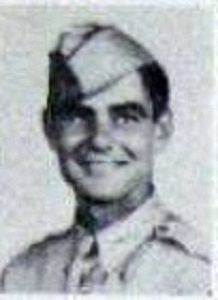
Photo source: Peter Schouteten, Arie-Jan van Hees, Pilot Class Book 42-J, Merced Army Air Field, California, Pilot Class Book 42-K, Corsicana, Texas