
Missing information?
Do you have any additional information you would like to share about a soldier?
Submit- Full
name
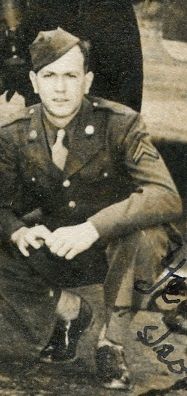
BRIDGE, Arlie R Jr - Date of
birth
8 August 1921 -
Age
21 -
Place of birth
New York -
Hometown
Carthage, Jefferson County, New York
Personal info
Military service
- Service
number
32476406 -
Rank
Staff Sergeant -
Function
Tail Gunner -
Unit
544th Bombardment Squadron,
384th Bombardment Group, Heavy
-
Awards
Purple Heart,
Air Medal
Death
-
Status
Killed in Action - Date of
death
25 July 1943 - Place of
death
In the mouth of the Eider River, 4 km from Vollerwiek, Germany
Grave
-
Cemetery
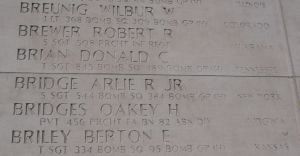
American War Cemetery Margraten - Walls of the Missing
Immediate family
-
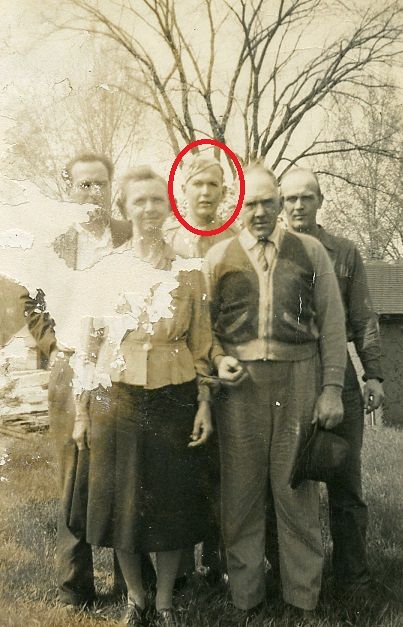
Members
Arlie R. Bridge (father)
Lena Bridge (mother)
Glenn Bridge (brother)
Blanche Bridge (sister)
Eugene Bridge (brother)
Lyle Bridge (brother)
George Bridge (brother)
Plane data
- Serial
number
42-3075 -
Data
Type: B-17F
Nickname: Longhorn
Destination: Hamburg, Germany
Mission: Bombing of the Blohm & Voss shipyards
Biography
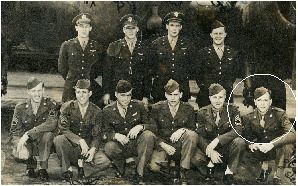
Arlie Jr. en zijn crew: een terugblik (De Maasgouw)More information
S/Sgt Arlie R. Bridge Jr. worked in a paper factory.He enlisted in Syracuse, New York on 17 September 1942.
He was the youngest of six children.
The plane suffered damage from flak and fell out of formation with the #3 engine smoking, and the entire nose shot up badly. One crewman was seen lying in the nose, apparently dead. Another fell from the nose and was thrashing about, apparently his chute wouldn't open. The aircraft was still under attack from the rear as it crashed in the mouth of the Eider River. It crashed into deep water, burned, and sank.
Three crew members survived and were taken prisoner; seven were killed.
On 1 August, the Harbor Security Detachment of Bussum found the remains of an American flyer on a sand bank on Blauort. These remains were so badly decomposed that they were falling apart, and therefore, the salvaging of the body was impossible, and the remains were buried on the spot in the mud. In 1947, the American Graves Registration Command tried to locate the grave. The burial site was supposedly marked with a rock; however, since the burial, the sands of the beach had been constantly shifting, and the water line of the island itself had changed considerably, so no traces of any human remains could be located in the entire area that was excavated.
Source of information: Raf Dyckmans, Geert en Marie-José Venner, Memories of the 384th Bomber Group (Heavy), Footnote, www.archives.gov - WWII Enlistment Record, IDPF, De Maasgouw (jaargang 134, 2015, p. 75-82)
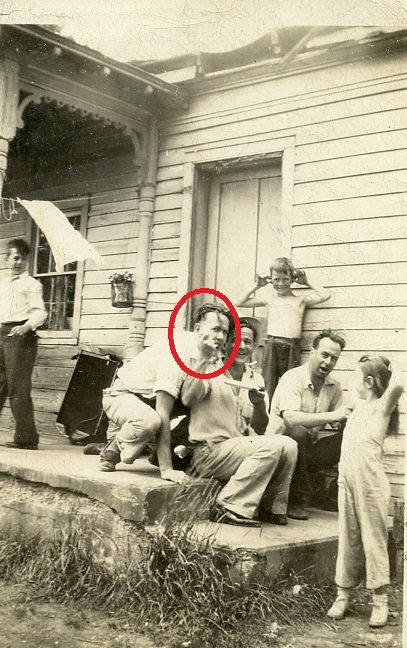
Photo source: Mireille Goedhart, Charles F. Bridge II