
Missing information?
Do you have any additional information you would like to share about a soldier?
Submit- Full
name
PITTMAN, George Glenn - Date of
birth
5 December 1907 -
Age
37 -
Place of birth
Etna, Kosciusko County, Indiana -
Hometown
Kosciusko County, Indiana -
Ethnicity
White
Personal info
Military service
- Service
number
T-126100 -
Rank
Flight Officer -
Function
Pilot -
Unit
81st Squadron,
436th Troop Carrier Group
-
Awards
Purple Heart,
Air Medal with Oak Leaf Cluster
Death
-
Status
Killed in Action - Date of
death
24 March 1945 - Place of
death
North of Wesel, Germany
Grave
-
Cemetery
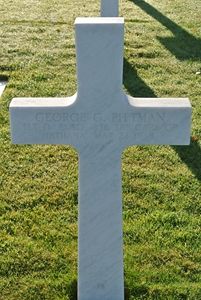
American War Cemetery Ardennes
| Plot | Row | Grave |
|---|---|---|
| A | 9 | 15 |
Immediate family
-
Members
William E. Pittman (father)
Nellie A. (Sprague) Pittman (mother)
Bernice Pittman (sister)
Olive L. Pittman (sister)
Edna E. Pittman (sister)
Helen M. Pittman (sister)
Helen (Girard) Pittman (wife)
Plane data
- Serial
number
45-6186 -
Data
Type: CG-4A
Destination: Landing Zone S, northeast of Wesel, Germany
Mission: Infantry Drop
MACR: 13362
More information
F/O George G. Pittman entered the Air Corps on 11 September 1942 at Roswell Army Air Field in New Mexico.On board of the CG-4A Glider were two crewmembers, F/O George G. Pittman and F/O John J. Sweeley Jr. and seven passengers, Major Andrew J. Hundley, Lt. Everett W. Loomis, S/Sgt Michael T. Cherkola, Pfc. Forest K. Martin, T/4 James A. Coyle, Pfc. Earl J. Leek and Pfc. Donald R. Hebebrand. Pfc. Hebebrand was the only survivor.
The following information was taken from the account Pfc Donald R. Hebebrand gave concerning the loss of a Glider missing in action 24 March 1945.
Pfc Hebebrand states that he was one of six members of the 1st Battalion, 194th Glider Infantry, 17th Airborne who took off in a Glider on the morning of 24 March 1945. He states that he saw the pilot and co-pilot but did not hear their names.
As they climbed out of the Glider, after landing in a field near Wesel, Germany, the Germans opened fire on them with 88mm Guns and small arms hitting every man and setting the Glider on fire. To Pfc Hebebrand’s knowledge the seven other men were killed instantly. Since he was not hit fatally himself he escaped death only by playing dead until other American Gliders landed on the field about two hours later. His conviction that the other men were dead was strengthened by the fact that they did not move when he stood up to signal the Americans.
Pfc Hebebrand further states that his Battalion Commander, Colonel Barnett returned to the field after questioning him at the Aid Station concerning a Major Huntley Battalion Executive Officer who was in the flight. Pfc Hebebrand learned only that they found the Major dead. He heard no further word about the other members in the flight or of the pilot or co-pilot.
Source of information: Terry Hirsch, www.wwiimemorial.com, www.abmc.gov, www.fold3.com – MACR, www.ancestry.com – Headstone and Interment Record / Family Trees / WWII Draft Card
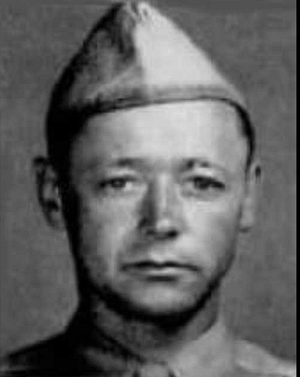
Photo source: Peter Schouteten, www.ancestry.com - courtesy of Kathy McDermott