
Missing information?
Do you have any additional information you would like to share about a soldier?
Submit- Full
name
BRITTAIN, Arthur Edward - Date of
birth
1 February 1924 -
Age
19 -
Place of birth
Spartanburg, Spartanburg County, South Carolina -
Hometown
Hyattsville, Prince George's County, Maryland
Personal info
Military service
- Service
number
13096046 -
Rank
Technical Sergeant -
Function
Radio Operator -
Unit
545th Bombardment Squadron,
384th Bombardment Group, Heavy
-
Awards
Purple Heart,
Air Medal with Oak Leaf Cluster
Death
-
Status
Missing in Action - Date of
death
12 August 1943 - Place of
death
Volmershoven, Germany
Grave
-
Cemetery
American War Cemetery Margraten - Walls of the Missing
Immediate family
-
Members
Thomas P. Brittain Sr. (father)
Fannie O. (Wingo) Brittain (mother)
Juanita Brittain (sister)
Thomas P. Brittain, Jr. (brother)
Martha L. Brittain (sister)
Judith Brittain (sister)
Plane data
- Serial
number
42-3231 -
Data
Type: B-17F
Nickname: The Inferno
Destination: Gelsenkirchen, Germany
Mission: Bombing of the synthetic oil refinery
MACR: 287
More information
Brittain's father was Captain T.P. Brittain (retired) who spent thirty years with an army medical detachment and served in World War I. He stated that his son's army age was 19 years, but added that the boy quit school to enlist in June 1942. Arthur Brittain attended Hyattsville High School and St. John's School in Washington.Arthur E. Brittain hitchhiked 2,500 miles in May 1943 to rejoin his outfit after being quarantined in Newfoundland with the Mumps. He and his buddy, Sgt Alfred Meyers of Nutley, N.J., had trained together with their bombardment echelon out in the West before they wound up in a Newfoundland hospital, just at the time when the rest of their group left for England. Eighteen days later, the "orphans" of the squadron emerged from the hospital. A major whom they were to see about their orders had returned to the United States. So they saw a colonel, who arranged for them to go as extra baggage on a Skymaster cargo-transport plane, headed for England. They got to the airfield destination of the transport with exactly a dime between them. Then they talked the army's Railroad Transport Office out of two railroad tickets for themselves and got to a replacement center somewhere in England. Intelligence officers at that point finally located the American bomber group to which Brittain and Meyers belonged, and they at last rejoined their outfit. Two days later, they went on their first raid.
The aircraft was engaged in a fight with six or seven enemy fighters, which caused the bomb bay to catch fire.
It was assumed that the airplane crashed in the vicinity of Metternich or Liplar-Erfstadt.
Six crew members survived and were taken prisoner; four were killed. According to German records, they were initially buried at Gross-Vernich. However field investigation conducted on 13 February 1951 failed to locate the remains.
Further investigation revealed that most certainly the airplane didn't crash in Metternich or Liplar-Erfstadt but in Volmershoven and that the four killed crew members were buried in boxes at the cemetery of Witherschlick on 13 August 1943 as unknowns.
These remains were disinterred either on 23 March 1945 or 8 March 1946 by a U.S. team and evacuated to Margraten. At that time, the investigation team recommended further efforts to trace these four unknown casualties at Margraten. The results of this investigation are not known.
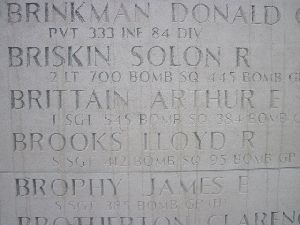
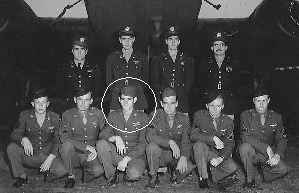
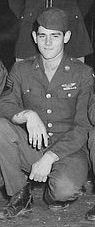
Source of information: Raf Dyckmans, www.memorial.com, www.newspapers.com - The Baltimore Sun, www.ancestry.com - Family Tree / 1940 Census / Passenger and Crew List, IDPF
Photo source: Jac Engels / Michel Beckers, http://384thbombgroup.com