
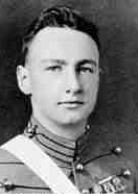
Missing information?
Do you have any additional information you would like to share about a soldier?
Submit- Full
name
WOOD, Eric Fisher Jr - Date of
birth
25 January 1919 -
Age
25 - Place of
birth
California -
Hometown
Bedford, Bedford County, Pennsylvania
Personal info
Military service
- Service
number
O-517724 -
Rank
First Lieutenant -
Function
Executive Officer -
Unit
A Battery,
589th Field Artillery Battalion,
106th Infantry Division
-
Awards
Distinguished Service Cross,
Silver Star,
Bronze Star,
Purple Heart,
Belgian Croix de Guerre,
Belgian Knight Order of Leopold with Gold Palm
Death
-
Status
Killed in Action - Date of
death
17 December 1944 - Place of
death
Meyerode, Belgium
Grave
-
Cemetery
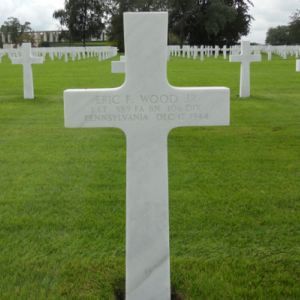
American War Cemetery Henri-Chapelle
| Plot | Row | Grave |
|---|---|---|
| G | 3 | 46 |
Immediate family
-
Members
Eric F. Wood (father)
Alec Wood (brother)
Peter Wood (brother)
Eleanor Wood (sister)
Margaret Wood (wife)
Pamela Wood (daughter)
Eric F. Wood III (son)
Eric F. Wood (grandson)
More information
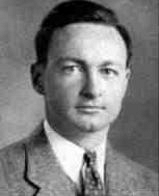
Lt Wood attended Valley Forge Military Academy and graduated from Princeton University in 1942.He enlisted in Altoona, Pennsylvania on 1 April 1943 and was sent overseas in November 1944.
This might be one of the most heroic and unlikely stories of the Battle of the Bulge: a young officer acting like Rambo in the Ardennes woods.
This is the story of Eric Fisher Wood:
Eric Wood was a 1st Lt with the with Battery A, 589th Field Artillery Battalion, 106th Infantry Division and was stationend in Herzfenn, Germany on 16 December 1944. Because the battery commander, Cpt Menk,e was taken prisoner, when the CP was overrun, Lt Wood was in charge of the A battery.
During the first day of the battle, Woods troops were the last ones to retreat from the Losheimer area. The calvary had allready retreated, leaving a wide gap open at the north flank. At about 14.00 hrs three Sturmgeschutze rolled down the road to Auw and came in sight of the 589th FAB. Wood, who heard the first tank approaching the HQ building, ran up a small hill to get a clear view on the road. He gave direct orders to Sgt George Shook and Cpl John Gatens to man the gunners position. Without having a clear sight on the tanks, Gatens managed to take out the first tank. Right after that, all four remaining 105mm howitzers opened fire on the other tanks. Woods direct approach stalled the German attack for hat moment.
What Wood and his men did not know, was that the Germans were building up their strength in this sector. They only needed some time to go for the big push. And when they did that, it would crush Woods battalion.
When night fell, the order was given to fall back, taking their howitzers to the rear. That was easier said then done. The trucks, which were used to tow the howitzers, made a muddy mess of the roads, which made it difficult to get the guns on the road. C Battery even had a harder time: they did not manage to get all of their guns on the road again and had to destroy them. Without the howitzers, C Battery could get out to the Belgian border much faster. On the right side of the road, known as Skyline Drive, the men took new positions. B Battery went into the field as first, together with three of A Battery’s howitzers. The last howitzer was used as a roadblock and the truck that towed it, got damaged.
That next morning, 17 December, the Germans launched a big attack. Pushing through Andler (Andlermuhle) from the north and another force was coming from the south, out of the direction of Bleialf. Overseeing this, Major Arthur Parker gave the order to pull back, towards Schönberg and move up to St. Vith.
Wood ordered his men to pull back with two of the three guns, leaving Wood and a gun crew behind to help getting the third gun, which got stuck, moving again. Time was running out and the Germans were overrunning the crew. The crew abanded the guns, but Wood and his men got the howitzer back on the road. The lead of the column allready had reached Schönberg.
B Battery drove like hell to catch up with Wood and the others. By the time A Battery reached Schönberg, the village was already crowded with enemy troops. A German tank ambushed Woods truck and the men left it.
The crew only had one heavy weapon, an M1 bazooka, wich was dragged around by Pfc Campagna and Scannapico. The rest of the crew had only M1 carbines.
The tank pulled back into town, which gave the two bazooka men the chance to approach it. They found it next to a house. Campagna's first shot missed. Truck driver Kenneth Knoll, who got the truck on the road again, slowed down to let Scannapico in. Unfortunatly Knoll was killed by machine gun fire. Another guy took over the wheel, crossed the Our bridge and drove the truck right into the center of the town. They saw another enemy tank. All men jumped out of the truck, just before the tank blasted the engine with an HE shell. The men, accompanied with some African Americans from the 333rd FAB, dove into a ditch and the situation seemed hopeless with firing Germans everywhere. The men started to surrender. But not Wood. He stood up and started to run, crossed the road, ran through an open field and made it to the woods.
That next day, 18 December, Peter Maraite, was looking for a nice christmas tree in the woods of Meyerode. Whatever the circumstances were, he wanted a tree for his family. When he was pulling away some low hanging treebranches, he found two American soldiers. One guy was a tall officer and the other one was a soldier, armed with a rifle In the heavily wooded area of the Ommerwald, just north of the main road, Wood had met up with another soldier separated from his unit). Peter didn't speak a word of English, but he tried to tell the men not to be afraid of him. He convinced them to follow him to his home, knowing that if he got caught by the Germans, escorting these two Americans, it would had huge consequenses for him and his family.
At Peters home, accompanied by his neighbour, Johann (or Jean) Schroder, who spoke English, Peter listenedto the story of Eric Fisher Wood. Wood explained that he wanted to go to St. Vith to join the 589th FAB. Peter Maraite told him that the way to St. Vith was crowded by Germans and it was too dangerous. Wood insisted to go to St. Vith. He would fight his way back to his battery or he would start his own personal war against the Germans in the woods, looking for Germans who stayed behind.
The Maraite family drank and ate with the two men and Wood was very optimistic about his plans to reach St. Vith. Wood and the soldier cleaned their weapons and slept till next morning.
It was still dark when Peter woke the men up. An hour later, he escorted the men to the woods. It was the last thing he ever saw of the two men.
But…. A few days later the civilians of the tiny town heard the noise of some rifle fire and explosions. And that was very perculiar, because the frontlines had already moved several miles to the west. Peter was guessing that it came from the two soldiers, who stayed in his home. Later, there were more sounds of gunfire. And they only occured when small groups of German soldiers entered the woods and never when big columns got in. From the German soldiers they heard that there were saboteurs and guys from the resistance were hiding in the woods. Snowploughs, needed to keep the roads open, were heavely armed with guards. Even Sepp Dietrich, who’s HQ was in the house of the mayor of Meyerode, kept complaining about “the scoundrels and bandits”. General Dietrich issued orders to his SS units to find and eliminate them.
For Peter Maraite it was clear: Eric Fisher Wood was doing what he had said he was going to do: he started a guerilla war against enemy troops.
On 23 January 1945, the little town of Meyerode was liberated by American troops for the second time in five months time. The civillians wanted to know what was going on for weeks in their woods. Their mayor, Jean Pauels, send two woodmen, August Pauels and Servatius Maraite, to take a look.
A mile south of the town, not far from the six way trail crossing, they found the frozen body of an American soldier. Around him, there were seven dead German soldiers. A unit of the 424th Graves registration came to the town to collect the body. A source mentions this was on 25 February 1945. They found out the the American soldier was Eric Fisher Wood. According to doctors, who were joining the Graves Registration unit, Wood was killed on 22 January, just one day before the liberation of the town.
Another source stated that it was estimated that Wood and the Germans had been dead for about ten days.
The Belgians claim that Eric Wood had not been touched by any Germans, because his identity tags and more than 4,000 Belgian francs were found on his body. German soldiers routinely searched the Allied dead, looking for side arms, documents, and money.
The graves registration unit not only found Wood’s body and the seven German soldiers. They found about 200 dead German soldiers, buried in shallow graves, some of them were stripped of their equipment. They also found burned out trucks. German soldiers stated that the woods were fierefull, because of small units of American soldiers, led by tall young officer.
In May 1945, the family Maraite was visited by the father of Eric, Eric Fisher Wood Sr, an American Army general. He showed some pictures of soldiers and asked the Maraites if they recognised any of the soldiers. Peter and his daughter Eva recognised one of the men as being the one who was in their home on 17 December 1944. It was Eric Fisher Wood jr.
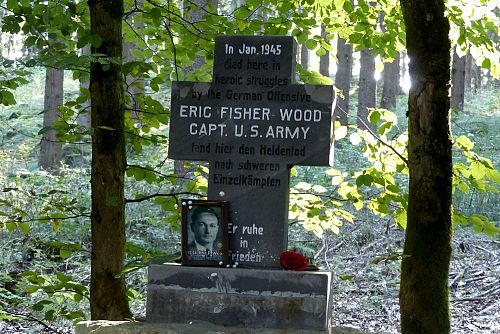
The general, together with the people of Meyerode, donated a memorial cross, which was placed in the area where Eric was found. General Wood also donated a chalice to the church, in gratitude for their hospitality.
For these actions Erc Wood was awarded the Distinguished Service Cross posthumously. The citation reads: for extraordinary heroism in connection with military operations against an armed enemy while serving as Executive Officer of Battery A, 589th Field Artillery Battalion, 106th Infantry Division, in action against enemy forces from 17 December 1944 to 22 January 1945, near Schônberg, Belgium. Lt Wood's section, the rear element of the withdrawing battalion, was cut off and completely surrounded, his vehicle was destroyed by enemy tank fire, and hostile infantry covered the surrounding area with a hail of small-arms fire. Refusing to surrender, as enemy fire converged on him from all sides, he raced across a large open field into the woods beyond. Cut off from all possibility of returning to his own lines, far inside enemy territory in the Ardennes wilderness in the dead of winter, he rejected any temptation to surrender. Not content to maintain his liberty behind the enemy lines, on company with several other Americans in the area, he repeatedly initiated ambush attacks against enemy communications, supply columns, and patrols, accounting for the deaths of scores of the foe. Valiantly, Lt Wood continued his offensive action until finally in a last fierce engagement with overwhelming forces he made the supreme sacrifice, where later his body was found surrounded by the bodies of seven of the enemy, mute testimony to the daring, the loyalty, and the intrepid gallantry of Lt Wood in the service of his country. 1st Lt Wood's intrepid actions, personal bravery and zealous devotion to duty at the cost of his life, exemplify the highest traditions of the military forces of the United States and reflect great credit upon himself, the 106th Infantry Division, and the United States Army.
In August 2020 legislation was introduced to award the Medal of Honor to Lt Wood.
Source of information: Peter Schouteten, Raf Dyckmans, www.wwiimemorial.com, www.archives.gov, http://www.in-honored-glory.info/, www.ancestry.com - Bedford Gazette - 16 March 1945
Photo source: Siem Voogt, www.findagrave.com