
Missing information?
Do you have any additional information you would like to share about a soldier?
Submit- Full
name
CARLETON, John R "Jack" - Date of
birth
11 August 1922 -
Age
22 -
Place of birth
Point Pleasant, Ocean County, New Jersey -
Hometown
Point Pleasant, Ocean County, New Jersey
Personal info
Military service
- Service
number
32759057 -
Rank
Private First Class -
Function
Rifleman -
Unit
G Company,
2nd Battalion,
120th Infantry Regiment,
30th Infantry Division
-
Awards
Silver Star,
Purple Heart
Death
-
Status
Killed in Action - Date of
death
27 February 1945 - Place of
death
Garzweiler, Germany
Grave
-
Cemetery
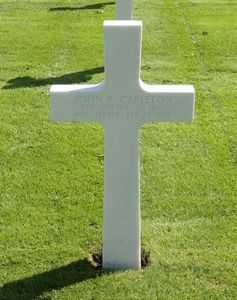
American War Cemetery Margraten
| Plot | Row | Grave |
|---|---|---|
| G | 7 | 2 |
Immediate family
-
Members
Robert Carleton (father)
Anna Carleton (mother)
Roberta M. Carleton (sister)
Ruth Carleton (sister)
Isabelle Carleton (sister)
Robert Carleton (brother)
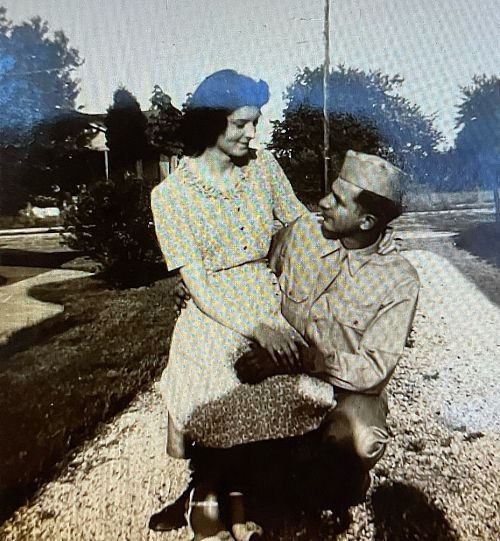
Audrey E. (Holley) Carleton (wife)
More information
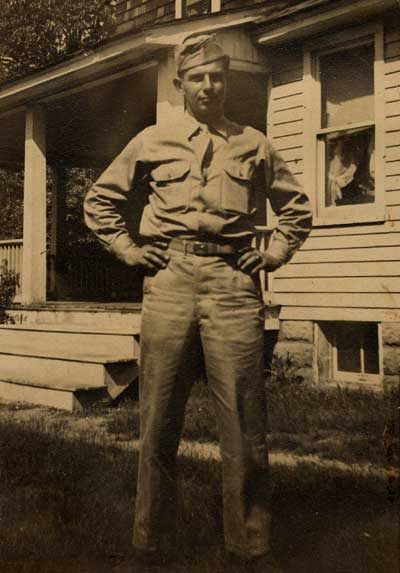
Pfc John R. Carleton was awarded the Silver Star Medal posthumously.Below is a story, send by the son of Sgt Prenger, who was like a brother to John Carleton to the adopter of his grave at Margraten:
Jack's story for Veterans Day, as told to me by my father, TSgt Henry B. Prenger, Co. G, 2nd Bat, 120th Reg. The story begins shortly after my father was wounded at Mortain....
When I got back to the front, everything was different. The stagnant war had changed, the Germans were beaten badly at Mortain and were running, we were running after them, and my company was full of new men, replacements for all that were lost in Mortain. I was different too. I'd started off as an outsider and had tried pretty hard to make friends, but now, I didn't want to make friends. It was too hard losing them. Better to keep my distance and then it wouldn't hurt as bad when they were killed.
I was given a promotion, to Sergeant, and a new assistant gunner named Jack Carleton. Jack was like me when I started out, desperate to make friends, desperate to be one of the guys. I wasn't having any of it. I wasn't rude, but I kept my distance.
We were traveling through beautiful country now, liberating French towns and villages along the way. We went through Chantily, Roye, Peronne, Cambrai, Valenciennes, and St. Armand, just to name the larger ones. These people had been under the Nazis for years and they were finally free, and I was a part of that. It was an incredible feeling. The old men and women waved at us with tears in their eyes and the young women threw their arms around us and kissed us. The wine flowed, the people cheered, and we all felt that this thing might be over before Christmas.
We moved so fast that there were problems keeping us supplied. We marched fifteen, twenty, even twenty-five miles in a day. We had a lot of stragglers, but even though my leg hurt, and I had trouble trying to keep up, I was determined I wasn't going to one of the guys that dropped out. Then, in the middle of a march that took us over 70 miles in three days, I got a terrible case of dysentery. The army gave you enough toilet paper to go once a day and I was going once an hour, squatting by the side of the road and then trying to catch back up again. Everybody in the platoon was passing toilet paper up and down the line to me.
I finally hit a point when I didn't think I was going to make it anymore. I was squatting by the side of the road, my leg was killing me, I had terrible pains in my stomach, and I was trying to wipe myself on two sheets of toilet paper. The thought hit me that I could just sit down and wait for the end of the day when a truck would come to pick up the stragglers, but I hated to do it. It's probably the Irish that's in me, I just did not want to quit. Just as I was about to give in, the new guy, Jack, came over to me and said, "Let me carry that pack for you," and he slung my mortar and backpack over his shoulder. My pack, with my mortar, weighed over sixty pounds. Jack's pack weighed over fifty pounds. So together, he carried nearly a hundred and twenty pounds on his back. And he did it for the rest of the day.
After that, the barriers came down. Jack and I were friends. Not just friends, we became close friends, and then we became as close as brothers. Jack was the best assistant gunner I ever had. A good mortar team could fire about 25 to 30 rounds a minute. Jack and I could almost double that. Sometimes, Jack was so quick, I worried that he was going to drop a round down the tube before the previous round had left the chamber.
Mail came sporadically, and you usually got nothing and then a bunch all at one time. Jack got a lot of letters from his sister, who he was really close to, but his wife would never write him, she would just send newspapers from home. They were newly married, war brides, and he used to write to her and ask her to please stop sending the papers, he just wanted a letter from her, but she never wrote. He would get so frustrated when one of those damn newspapers from home would arrive and there wouldn't even be a note inside.
It was a couple of days after the Roer River crossing. We had taken a town, the Germans had moved out, and Jack and I decided to scavenge around a little farmhouse on the edge of the town to see if we could find some fresh eggs to supplement our K rations. Jack had turned the corner of the building, about twenty feet ahead of me, and was heading back toward the barn when we got hit with a tremendous artillery barrage. I dove through a basement window and ended up in a pile of potatoes on the basement floor, and I burrowed down into the potatoes.
After about a minute, when the barrage let up, I could hear screaming outside. Crawling back out of the basement window, I could see a jeep had been hit out on the road and both of the men that had been in it were laying on the ground next to the battered jeep, shrieking in agony. I ran as quick as I could to the jeep, and as I got close, I could see that one of the soldiers was already dead and the other, who was still alive, had both of his legs blown off. It was horrible. Blood was pouring out where his legs had been, and he was screaming out for me to help him to ease his pain.
Sergeants were supplied with morphine syringes, and I had two of them. I injected both of them as fast as I could, the whole time yelling for Jack to come and help me. I sat there with this poor guy as he screamed in pain and shock and I held him until he finally stopped, and his body relaxed in my arms. He was dead, and I was shaken and upset that Jack had never come when I called him.
I left the poor man by the jeep and I started to call out angrily for Jack, mad that he had not come to help me. Then I turned the corner of the house and Jack was lying motionless on the ground, like he was sleeping. At first, it didn't look like he had a mark on his body, but when I looked more closely, I found a small spot of blood on his forehead. A sliver of shrapnel, about as big as a small nail, had pierced his skull, killing him instantly.
It was hard to get my head around it. It had come out of the blue. The battle, for that day, had been over and we were just goofing around trying to find some food. The artillery barrage had been violent but brief. All this and the fact that his wound look so slight with hardly any blood, made me struggle with the fact that he was really dead.
I sat there with him for a long time. I couldn't move. I didn't want to leave him alone. Finally, it started to get dark and I knew I had to get back to my platoon. Jack was one of the smart guys. He had it in him to make it through the war. It was very hard to take. I didn't want to make any more friends.
Jack's sister wrote me later in the war. I told her what I could, what a great man he was, what a wonderful comrade, how brave he was, how much he had loved her, and how frustrated he was with his wife. I still have the letter she sent me.
Source of information: Raf Dyckmans, www.abmc.goc, www.wwiimemorial.com, www.oldhickory30th.com, www.30thinfantry.org, Wilma Syen-Meijers (grave adopter)
Photo source: www.findagrave.com - Des Philippet, www.wwiimemorial.com, Wilma Syen-Meijers