
Missing information?
Do you have any additional information you would like to share about a soldier?
Submit- Full
name
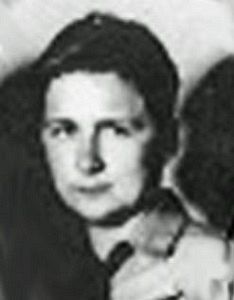
BUHL, Vernon - Date of
birth
12 August 1925 -
Age
19 -
Place of birth
Montana -
Hometown
Whitehall, Jefferson County, Montana
Personal info
Military service
- Service
number
39621427 -
Rank
Sergeant -
Function
Tail Gunner -
Unit
506th Bombardment Squadron,
44th Bombardment Group, Heavy
-
Awards
Purple Heart,
Air Medal
Death
-
Status
Killed in Action - Date of
death
7 October 1944 - Place of
death
Göthersloh, Germany
Grave
-
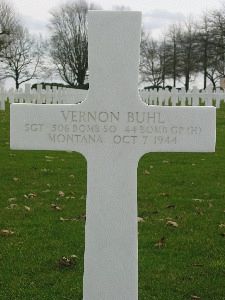
Cemetery
American War Cemetery Margraten
| Plot | Row | Grave |
|---|---|---|
| F | 21 | 18 |
Immediate family
-
Members
William Buhl (father)
Ellen A. Buhl (mother)
Ellis W. Buhl (sister)
Plane data
- Serial
number
42-40167 -
Data
Type: B-24J
Nickname: Sierra Blanca
Destination: Kassel, Germany
Mission: Bombing of the Henschel & Son aviation industry
MACR: 9342
More information
The airplane was hit by flak and set on fire.Radio Operator John Lord sent a tape of his experiences:
"September 1st was our first mission as a crew. The pilot, Still, and co-pilot Welborn had flown one other combat mission prior to this. But on our first mission, the tail hit a white fence at end of the runway-I could see pieces of the fence fly! We (later) dropped our 1,000 pound bombs through the bomb bay doors. Not a very good way to start. On the 7 October mission to Kassels, being the newest crew, we got one of the oldest planes to fly. It was patched up, my radio table was broken off, no place to write. (Editor's note: Aircraft received from the 492nd Bomb Group when that Group was deactivated.) When we opened the bomb bay doors, I could see the flash of flak guns shooting at us. We had trouble with one engine losing power, finally had to feather it. Not then being able to keep up with the formation, we began to fall behind. Our pilot, Homer Still, asked John Wilson, Navigator, for a heading to fly back over France. Another engine on the right side was lost, making two of them feathered on that side of the wing, and we were in deep trouble. About that time, I heard a loud POP and then saw our co-pilot, Welborn, open the top hatch and climb out! When I turned around and looked into the bomb bay, I saw the reason for that exit. It was full of flames. How was I to get out? Normally, I could have climbed up on the radio table and pulled myself up through that same top hatch, but the table was broken. I had my chest pack chute on, but in a dilemma as to what to do, when the plane made my decision for me- it turned upside down. I then fell out of that open top hatch-well, almost out. My heated suit and intercom plugs were holding me tight. I quickly broke or tore them loose and fell free. I found myself in a headfirst position and slowly spinning so that I had little sense of falling. I guess that my altitude at that time to be about 17,000 feet. Slowly, I saw the ground getting closer, pulled my pin, and thankfully saw my chute blossom out. Looking down, I could see a round, burning area of incendiaries, so I pulled on some shroud lines and missed the fire and landed in an open field. Then a large piece of the aircraft-the waist area-came down close to me. I suspect that the plane had exploded for that piece to hit like that. I had burns on my left hand and around my eyes. A young German lad of about 8 to 10 years old helped me with my chute. Then German soldiers came running up, holding pistols on me. I had landed close to a Signal Corps practicing in the woods, unfortunately, with no possibility of evasion. They took me to a dispensary, where I was bandaged on my hand and face. While I was there, several teenage boys, who had been manning a flak gun nearby, came in to see me. They thought they had us shot down. Both Dahlin and Wyant had been shot at as they were coming down. I also learned that Welborn hit his head on something when he left through the top hatch, severely damaging his eye. I later got gangrene in my burned left hand, was treated by some British doctors who had been captured earlier, but suffered no permanent damage-thanks to them."
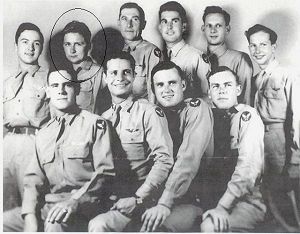
Seven crew members could bail out and were taken prisoner; three were killed. They were initially buried at the cemetery of Gütersloh.
After being disinterred, his remains were evacuated to Margraten and buried in a temporary grave on 1 June 1945. After the cemetery was given a permanent status, he was given his final resting place on 7 January 1949.
Source of information: Raf Dyckmans, Roger Fenton VP/Historian 44th BGVA, www.ancestry.com - Headstone and Interment Record / 1930 Census, IDPF
Photo source: Peter Schouteten, Stan Derkx