
Missing information?
Do you have any additional information you would like to share about a soldier?
Submit- Full
name
LOREE, Herbert Alexander - Date of
birth
14 August 1914 -
Age
30 -
Place of birth
Ottawa, Ontario, Canada -
Hometown
Thetford, Genesee County, Michigan -
Religion
Protestant
Personal info
Military service
- Service
number
36173672 -
Rank
Corporal -
Function
unknown -
Unit
C Company,
111th Engineer Combat Battalion,
36th Infantry Division
-
Awards
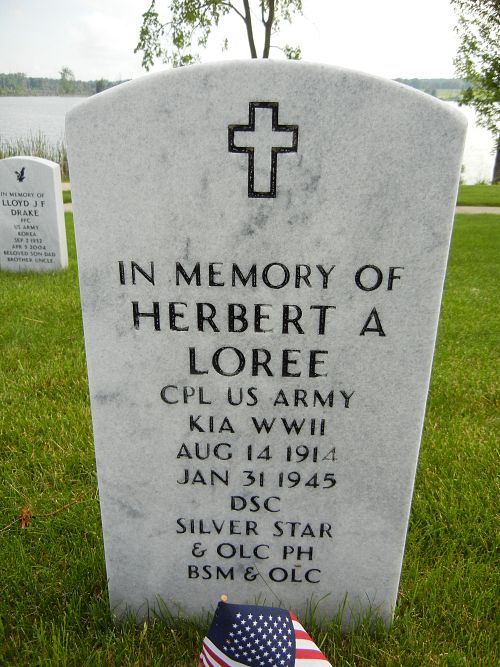
Distinguished Service Cross,
Silver Star with Oak Leaf Cluster Bronze Star with Oak Leaf Cluster,
Purple Heart with Oak Leaf Cluster
Death
-
Status
Killed in Action - Date of
death
31 January 1945 - Place of
death
In the vicinity of Bilwisheim, France
Grave
-
Cemetery
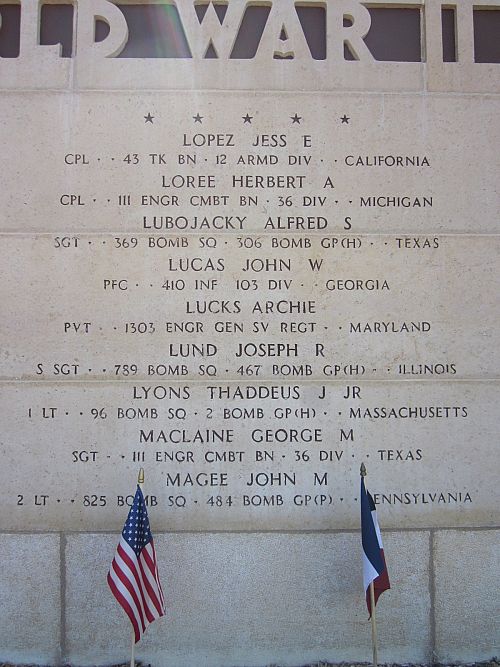
American War Cemetery Epinal - Tablets of the Missing
Immediate family
-
Members
Thomas W. Loree (father)
Sarah J. (Weatherdon) Loree (mother)
Jessie D. Loree (sister)
Sheila C. Loree (sister)
Emma T. Loree (sister)
Hazel E. Loree (sister)
William T. Loree (brother)
John F. Loree (brother)
Agnes L. Loree (sister)
Pansy P. Loree (sister)
Viola M. (Lanfear) Loree (wife)
More information
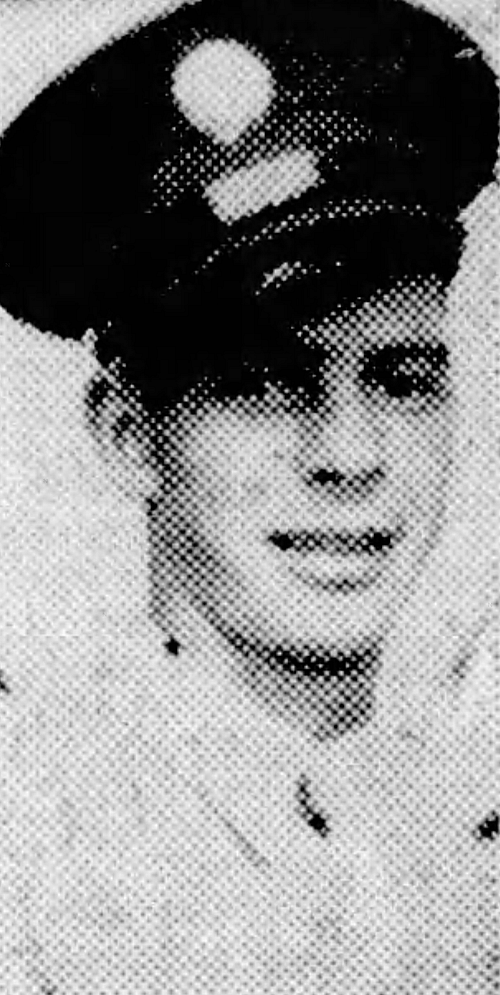
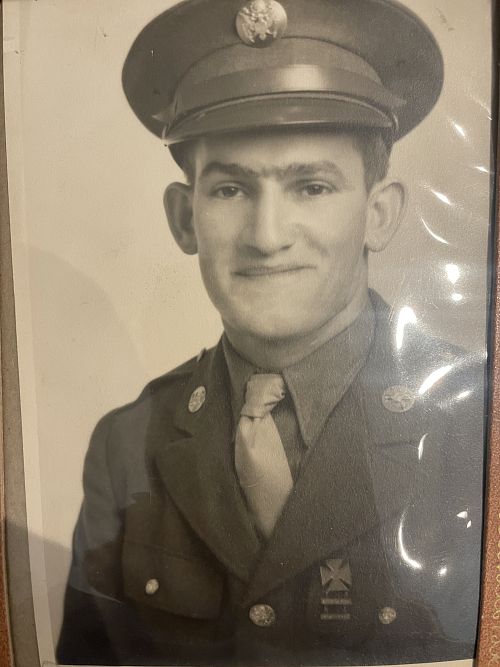
Cpl Herbert A. Loree was a driver at the Eaton Foundry Company before he enlisted at Fort Custer, Michigan on 26 February 1942. he was sent overseas in March 1943.He was awarded the Distinguished Service Cross. The citation cited: For extraordinary heroism in connection with military operations against an armed enemy while serving with Company C, 111th Engineer Combat Battalion, 36th Infantry Division, in action against enemy forces near Fays, France on 17 October 1944. Pfc Loree's extraordinary heroism, personal bravery and zealous devotion to duty exemplify the highest traditions of the military forces of the United States and reflect great credit upon himself, the 36th Infantry Division, and the United States Army.
For the second Bronze Star Medal he was awarded, the citation cited: Pvt Loree, instructed to blow machine gun emplacements for occupation by friendly troops, carried shape charges and TNT under heavy enemy artillery shelling to the specified positions. Although, after every charge was set off, he and his companions were subjected to intense, aimed mortar and small arms fire in addition to the ceaseless artillery barrage, they valiantly continued their important work and succeeded in blowing the required emplacements in spite of the constant hazard of hostile fire.
The second Silver Star Medal was awarded posthumously. The citation cited: For gallantry in action on 30 January 1945 in France. Friendly infantry elements were withdrawing to better defensive positions and Cpl Loree and three comrades were assigned the mission of destroying a bridge to prevent enemy armor form following. The bridge was under mortar fire which cut their demolition lines and, consequently they had to wait until all friendly troops had crossed before wiring the charges. After the infantry had withdrwan, they worked calmly, under heavy shellfire and enemy observation, to complete their mission. Although hostile tanks were operating within 300 yards of the bridge and enemy infantry elements were only a short distance away, Cpl Loree and his companions successfully demolished the bridge, preventing enemy armor from following the friendly troops. cpl Loree was wounded while performing this deed. He was killed in action on the following day.
The truck in which he was riding with seven other men of his unit, hit a land mine and exploded. The truck was completely demolished. The bodies of the six men were badly mutilated but no trace could be found of two men: Pfc Robert J. Sleator and Cpl Herbert A. Loree. It is believed that they were completely destroyed by the explosion.
He is remembered at the Great Lakes National Cemetery in Holly, Oakland County, Michigan.
The following was written by a family member, Mr. Mike Loree:
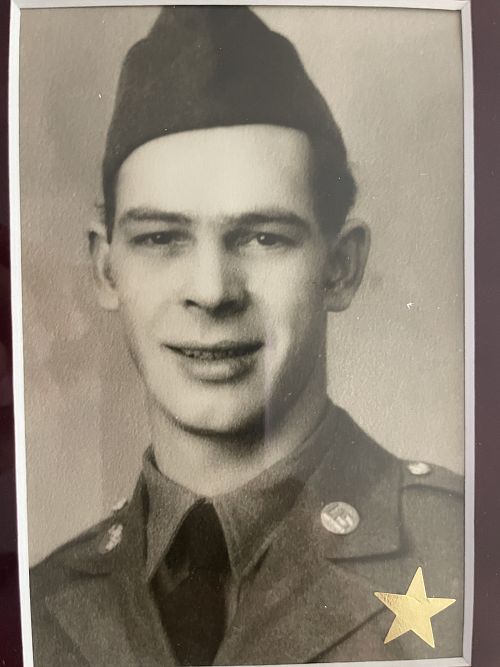
Uncle Herb was someone I never had the privilege of knowing. He was rarely spoken of due to the pain his loss still causes his sister, my mother, Sheilia C. (Loree) Smith, some sixty years after his death. In 2003 I had a call from a nephew, Jon Meredith. He informed me he had a box of medals and papers and he and his wife were thinking about having a display made. He was uncertain as to the circumstances leading to his having the medals and sought my advice. He knew of his grandmother’s sensitivity about her brother‘s death. I offered that displaying them, while it might cause a brief moment of pain, was preferable to another sixty years in storage.
I later saw Uncle Herb’s Purple Heart and the accompanying letter proudly displayed in Jon’s home. Mother related in one of our conversations that Uncle Herb was highly decorated. She was the one who typically accompanied her mother to the presentations. This is likely why her mother passed the medals and documentation to her. The Purple Heart and the conversations with Mother started me on a quest to learn more about Uncle Herb and to document his military service as best I could.
Mother had informed me Uncle Herb was killed in France and was buried there. I searched the Internet for Military cemeteries and found the American Battle Monuments Commission website. I input his name and learned he was killed on January 31, 1945. The record included a list of medals he had been awarded. I later learned as impressive as the list was that it was a only a partial list.
The record stated that Uncle Herb was awarded the nation’s second highest honor, the Distinguished Service Cross. He was also awarded a Silver Star with bronze oak leaf cluster. A bronze oak leaf cluster denotes the award of a second Silver Star. The Distinguished Service Cross is one of only two medals that award a pension to the recipient or his beneficiary. The other medal which carries with it a pension is the nation’s highest award, the Medal of Honor. His mother, Sarah J. Loree, received the pension for the balance of her life.
The record further stated that Uncle Herb’s name is inscribed on the Tablets of the Missing at the Epinal American Cemetery at Epinal (Vosages), France. He was a member of the 111th Engineer Combat Battalion, 36th Infantry Division.
I e-mailed Jon and inquired about any additional medals. He informed me
he had the Distinguished Service Cross, a Bronze Star with oak leaf cluster, and the Purple Heart with Oak leaf cluster he has framed. These original medals are inscribed with Uncle Herb’s name. The Silver Star with oak leaf cluster listed in the record is missing. Jon also had some documentation, newspaper clippings, and two snapshots of Uncle Herb.
I then requested a copy of Uncle Herb’s service records from NARA, the government records retention center in St Louis. I learned after a year that Uncle Herb’s military records were destroyed in a fire at the records center in the 1970’s. I did receive from NARA a complete set of replacement medals. Like the originals they are inscribed on the reverse with Herbert A Loree.
Information the family had and other sources revealed that Uncle Herb entered the service from Otisville, Michigan on February 23, 1942. Following basic and combat engineer training, he was assigned as noted above to Company “C”, 111th Engineer Combat Battalion, 36th Infantry Division.
The 36th Division website is very informative. It lead me to a discussion forum. There I found the son of an individual who served with Uncle Herb. That individual, John Pearce has the diary his father kept during World War II. The circumstances surrounding Uncle Herb’s death are noted in the diary.
The division embarked from New York on April 2, 1943 and arrived in Oran, Algeria on April 13, 1943. The division saw little action in North Africa. The war began in earnest for the 36th Division with their landing at Salerno, Italy on September 9, 1943.
Uncle Herb was awarded his first Bronze Star for his actions on January 29, 1944 in Italy. The citation describes his clearing of pathways through minefields using hand probing due to the presence of non-metallic Schu mines which were not detectable using the mine detectors of that period.
He received a second Bronze Star for his actions on February 24, 1944 also in Italy. On that date Uncle Herb was involved in blowing up machine gun emplacements using TNT and shaped charges.
On October 17, 1944 Uncle Herb earned the Distinguished Service Cross. The location was near Fays, France. Uncle Herb went in advance of an armored unit and cleared anti tank mines from two different road blocks. He had to make two trips of several hundred yards from relative safety to the road blocks. It took three hours to complete the work having to halt and lie in ditches from time to time to avoid enemy fire.
November 6 1944, again found him clearing mines under enemy fire so an armored unit could advance. For his actions that day he was awarded his first Silver Star.
On January 30, 1945 he and others demolished a bridge as enemy armor and infantry were approaching. He received a minor wound from a shell fragment during that action. He was later awarded his first Purple Heart and a second Silver Star.
Uncle Herb and seven comrades were killed the following day, January 31, 1945. This group had recovered 11 antitank mines and were returning them to the battalion dump when for unknown reasons there was a massive explosion. All eight men were killed instantaneously. Uncle Herb’s was one of the bodies never identified. That is why he is listed on the tablets of the missing at Epinal instead of having a marked grave.
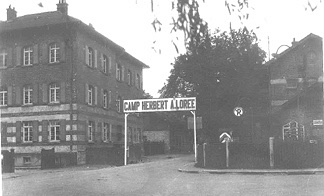
Perhaps Uncle Herb’s greatest honor came after the war in Europe ended. Combat engineer battalions were typically split up during World War II. This was the case for the 111th Engineers. The battalion operated in smaller units from July 6, 1944 until June 13, 1945 when they reformed as a battalion. They came back together at a former German officer training facility named “Altes Lager”. They renamed the facility “Camp Herbert A Loree”.
The following is taken from a military record of that time. “The main entrance to the post bears the overhead sign of “Camp Herbert A Loree”. Cpl Loree, 36173672, Otisville, Michigan was a well liked, excellent soldier both in and out of combat, who was killed in a mine explosion on 31 January 1945 when a three-quarter ton truck bearing eleven M-1, A-1 mines detonated. Fuses were frozen in the mines making it impossible for removal of same. The vehicle had just returned to the battalion dump in BILWISHEIM, FRANCE (WQ9412) when the tragedy occurred.”
You can find a photo of the entrance to Camp Loree on the internet by searching on “Herbert A Loree”.
The above does not do justice to a true American hero. He and thousands of others gave their lives so we can enjoy the freedom we have today. I encourage each of you to read the attached citations carefully to get a better understanding of this individual’s courage and the conditions under which each award was earned.
Documents
-
IDPF
6.38 MB
Source of information: Peter Schouteten, Raf Dyckmans www.abmc.gov, www.wwiimemorial.com, www.archives.gov, https://36th-id.frb.io, www.ancestry.com - Headstone and Interment Record / Loree Reunion Tree / WWII Draft Cards Young Men, www.findagrave.com – Katie Neal / Russ Pickett, www.newspapers.com – The Flint Journal - 24 February 1945
Photo source: www.findagrave.com – Misty / Destiny, www.newspapers.com – The Flint Journal - 24 February 1945