
Missing information?
Do you have any additional information you would like to share about a soldier?
Submit- Full
name
LINDSEY, Darrell Robin - Date of
birth
30 December 1919 -
Age
24 -
Place of birth
Jefferson, Webster County, Iowa -
Hometown
Jefferson, Webster County, Iowa
Personal info
Military service
- Service
number
O-729031 -
Rank
Captain -
Function
Pilot -
Unit
585th Bombardment Squadron,
394th Bombardment Group, Medium
-
Awards
Medal of Honor,
Distinguished Flying Cross,
Purple Heart,
Air Medal with 8 Oak Leaf Clusters
Death
-
Status
Killed in Action - Date of
death
9 August 1944 - Place of
death
Villa des Peupliers, Allée de Tilleuls
Saint-Prix, France
Grave
-
Cemetery
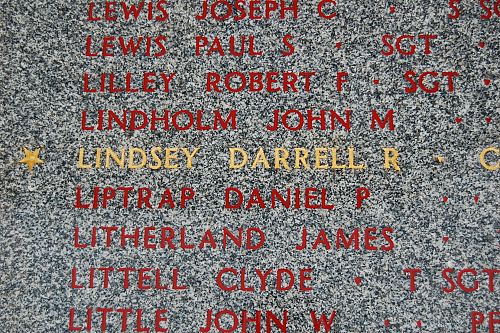
American War Cemetery Ardennes - Tablets of the Missing
Immediate family
-
Members
Jesse L. Lindsey (father)
Grace A. (Puffer) Lindsey (mother)
Lyle F. Lindsey (brother)
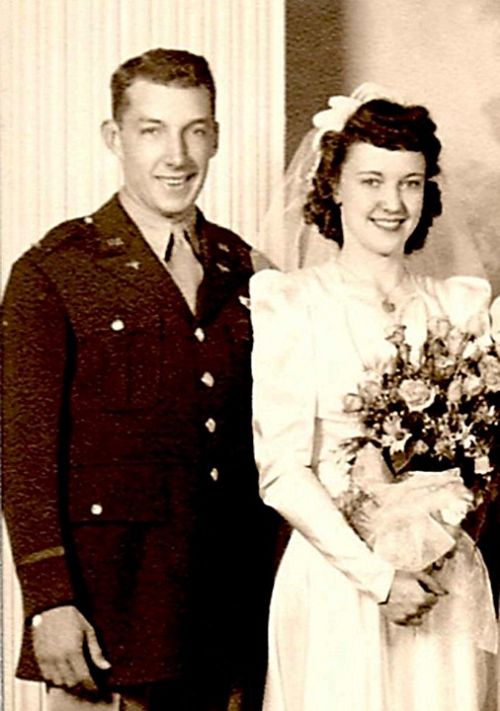
Evelyn (Scott) Lindsey (wife)
Plane data
- Serial
number
42-96101 -
Data
Type: B-26B
Nickname: My Aching Back
Destination: L’Isle-Adam, France
Mission: Bombing of a railroad bridge
MACR: 7847
More information
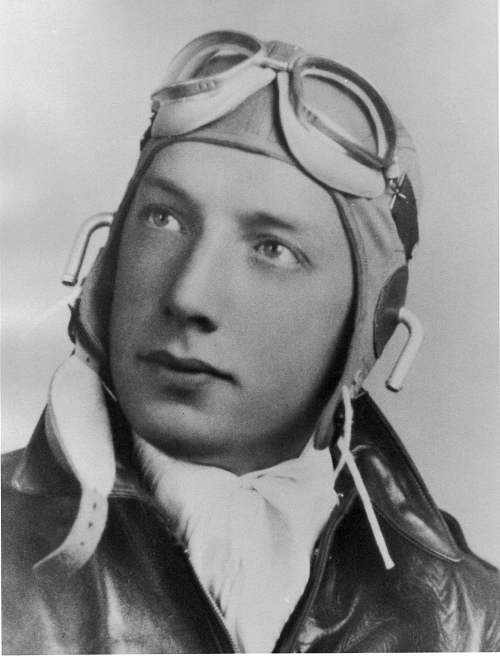
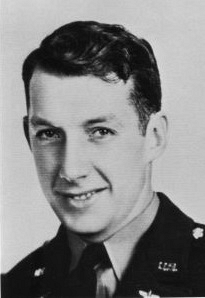
Capt Darrell Lindsey graduated from Fort Dodge High School in 1938, attended Buena Vista University and Drake University in Des Moines for two years.He volunteered for the Air Corps of the Army of the United States at Fort Des Moines, Iowa on 16 January 1942.
He received his wings and was commissioned a Second Lieutenant on 27 August 1942. He was sent overseas in February 1944 and flew in nearly 45 missions, logging 143 combat hours, before his death.
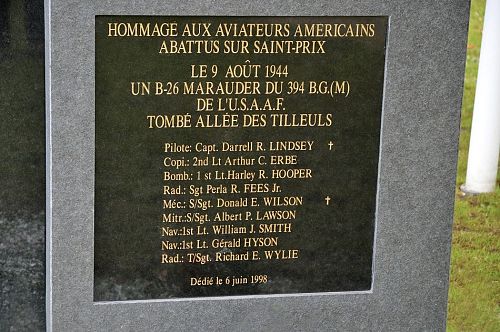
The airplane was hit by flak just after bombs away setting fire to the right engine and the crew bailed out. The aircraft then entered a step glide and was enveloped in flames thirty seconds later at 8,000 ft. It rolled over, dived into the ground and exploded at 2000 hrs at Villa des Peupliers at Saint-Prix, about seven miles southeast of Pontoise, France.
Two crew members were killed, four were taken prisoner and three evaded capture.
Capt Lindsey's remains were found by the Germans. The place where he was buried is not found until this day.
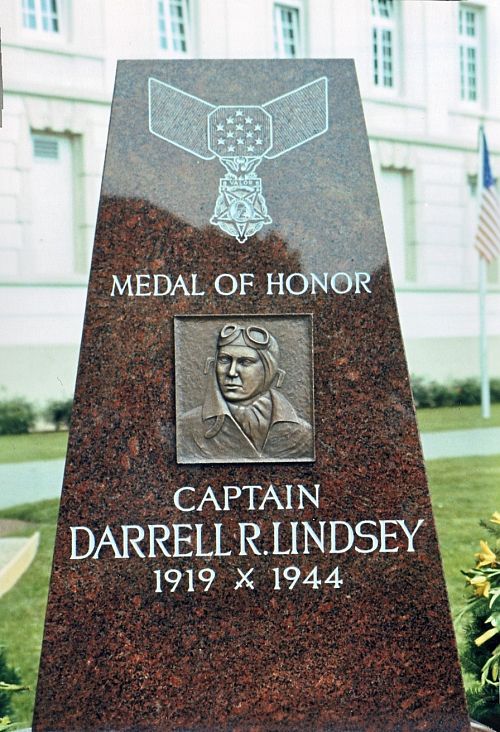
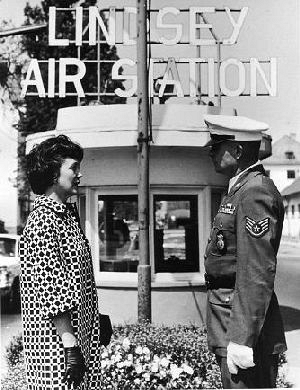
An air station in Wiesbaden, Germany was named after him. The station closed in 1993 and a red granite monument, that remembered him, was returned to Jefferson, Iowa and placed on the Lawn of the Green Country Courthouse.
He was awarded the Medal of Honor posthumously for his action during this mission. The citation cited: On 9 August 1944, Capt Lindsey led a formation of 30 B-26 medium bombers in a hazardous mission to destroy the strategic enemy held L'lsle Adam railroad bridge over the Seine in occupied France. With most of the bridges over the Seine destroyed, the heavily fortified L'Isle Adam bridge was of inestimable value to the enemy in moving troops, supplies, and equipment to Paris. Capt Lindsey was fully aware of the fierce resistance that would be encountered. Shortly after reaching enemy territory the formation was buffeted with heavy and accurate anti-aircraft fire. By skillful evasive action, Capt Lindsey was able to elude much of the enemy flak, but just before entering the bombing run his B-26 was peppered with holes. During the bombing run the enemy fire was even more intense, and Capt Lindsey's right engine received a direct hit and burst into flames. Despite the fact that his ship was hurled out of formation by the violence of the concussion, Capt Lindsey brilliantly maneuvered back into the lead position without disrupting the flight. Fully aware that the gasoline tanks might explode at any moment, Capt Lindsey gallantly elected to continue the perilous bombing run. With fire streaming from his right engine and his right wing half enveloped in flames, he led his formation over the target upon which the bombs were dropped with telling effect. Immediately after the objective was attacked, Capt Lindsey gave the order for the crew to parachute from the doomed aircraft. With magnificent coolness and superb pilotage, and without regard for his own life, he held the swiftly descending airplane in a steady glide until the members of the crew could jump to safety. With the right wing completely enveloped in flames and an explosion of the gasoline tank imminent, Capt Lindsey still remained unperturbed. The last man to leave the stricken plane was the bombardier, who offered to lower the wheels so that Capt Lindsey might escape from the nose. Realizing that this might throw the aircraft into an uncontrollable spin and jeopardize the bombardier's chances to escape, Capt Lindsey refused the offer. Immediately after the bombardier had bailed out, and before Capt Lindsey was able to follow, the right gasoline tank exploded. The aircraft sheathed in fire, went into a steep dive and was seen to explode as it crashed. All who are living today from this plane owe their lives to the fact that Capt Lindsey remained cool and showed supreme courage in this emergency.
A monument in the garden behind the city hall of Saint-Prix remembers the crash.
Source of information: Raf Dyckmans, www.wwiimemorial.com, ArmyAirForces.com, WW2Awards.com
Photo source: Jasper van Haren, Andrew Boehly, https://www.uswarmemorials.org/, Commemorative Air Force Facebook - 9 August 2025