

Missing information?
Do you have any additional information you would like to share about a soldier?
Submit- Full
name
LYNN, William George Jr "Bill" - Date of
birth
6 June 1915 -
Age
27 -
Place of birth
Detroit, Wayne County, Michigan -
Hometown
Los Angeles, Los Angeles County, California -
Ethnicity
White
Personal info
Military service
- Service
number
O-432081 -
Rank
Second Lieutenant -
Function
unknown -
Unit
15th Bombardment Squadron,
27th Bombardment Group, Light
-
Awards
Purple Heart
Death
-
Status
Killed in Action - Date of
death
4 July 1942 - Place of
death
Bergen-aan-Zee, the Netherlands
Grave
-
Cemetery
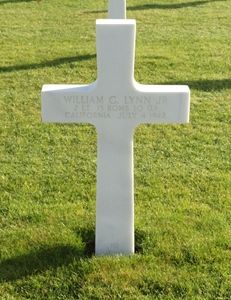
American War Cemetery Margraten
| Plot | Row | Grave |
|---|---|---|
| B | 5 | 10 |
Immediate family
-
Members
William G. Lynn (father)
Marion L. (Hayes) Lynn (mother)
Rachel (Wright) Lynn (wife)
Nancy R. Lynn (daughter)
Plane data
- Serial
number
AL741 -
Data
Type: Boston III
Nickname: V for Vernon
Destination: De Kooy airfield, the Netherlands
Mission: Bombing of the airfield
MARC: 115
More information
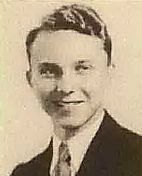
2nd Lt William G. Lynn Jr. graduated from Hollywood High School and attended the University of California.He joined the Air Corps of the Regular Army at March Fields Riverside, California on 24 April 1941 as an aviation cadet.
He was sent overseas in May 1942.
The 15th Squadron, operating in conjunction with the British 226th Squadron, attacked four airdromes in occupied territory at approximately 08:00 AM. Six A-20 American Aircraft flown by American crews operated in conjunction with six aircraft of simular type flown by British crews to attack the following four airdromes: De Kooy, Haamstede, Daltonburg and Burgon Alkmaar.
All planes were loaded with two 500-lb, 11 second delayed action fuse and 16 30-lb incendiaries.
Statement from Ira C. Eaker, Brig Gen:
"I was present at the briefing and talked to the British base and squadron commander and the returned crews. The two northern airdromes - De Kooy and Haamstede - were exceptionally heavily defended by light flak. The crews believed that this resulted from the fact that approaching aircraft passed over small boats en route to the target and personnel aboard these boats flashed a warning to the anti-aircraft defenses. The attacker on the two souther airdromes found no evidence that they were anticipated. Neither of our losses was the result of fighter action as far as can be determined. However, the British aircraft which was lost was undoubtedly damaged by light flak, slowed down, and later destroyed by a fighter."
The plane was shot down by flak and broke up in the air, north of Bergen-aan-Zee, the Netherlands.
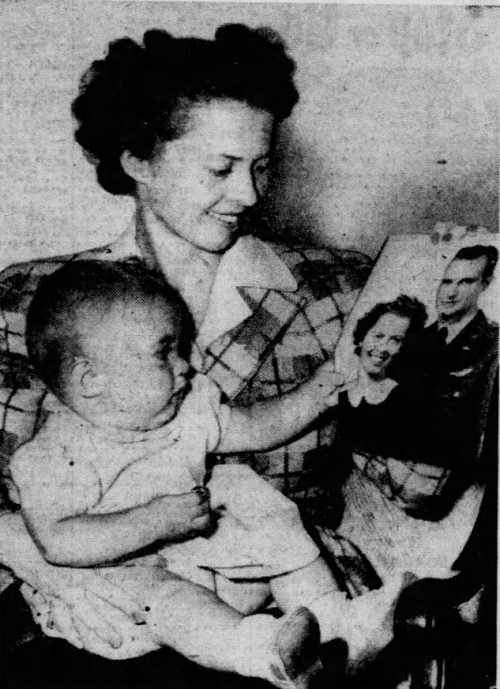
One picture shows his wife and daughter at the first anniversary of his death.
Source of information: Raf Dyckmans, Laura Phillips, Arie-Jan van Hees, www.abmc.gov, www.archives.gov - WWII Army Enlistment Records, www.wwiimemorial.com, www.usaafdata.com, www.fold3.com - WWII European Theater Army Records, www.ancestry.com - 1940 Census, Boston Traveler - 24 September 1942, The Los Angeles Times - 4 June 1943
Photo source: www.findagrave.com - Des Philippet, Hollywood High School yearbook 1933, www.ancestry.com - U.S. School Yearbook Los Angeles Junior College