
Missing information?
Do you have any additional information you would like to share about a soldier?
Submit- Full
name
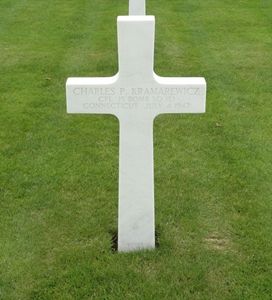
KRAMAREWICZ, Charles - Date of
birth
1920 -
Age
unknown -
Place of birth
Connecticut -
Hometown
New Haven County, Connecticut
Personal info
Military service
- Service
number
11019157 -
Rank
Corporal -
Function
Dorsal Gunner -
Unit
15th Bombardment Squadron,
27th Bombardment Group, Light
-
Awards
Purple Heart
Death
-
Status
Killed in Action - Date of
death
4 July 1942 - Place of
death
Bergen-aan-Zee, the Netherlands
Grave
-
Cemetery
American War Cemetery Margraten
| Plot | Row | Grave |
|---|---|---|
| I | 14 | 18 |
Immediate family
-
Members
Paul Kramarewicz (father)
Stefania (Wroblewska) Kramarewicz (mother)
Rose Kramarewicz (sister)
John Kramarewicz (brother)
Andrew Kramarewicz (brother)
Anna Kramarewicz (sister)
Stanley Kramarewicz (brother)
Benjamin Kramarewicz (brother)
Anthony Kramarewicz (brother)
More information
Cpl Charles Kramarewicz was a mechanic before he joined the Regular Army in Norwich, Connecticut on 9 January 1941.This was the first American air strike against German targets in Europe in World War II. The 15th Squadron, operating in conjunction with the British 226th Squadron, attacked four airdromes in occupied territory at approximately 08:00 AM. Six A-20 American Aircraft flown by American crews operated in conjunction with six aircraft of similar type flown by British crews to attack the following four airdromes: De Kooy, Haamstede, Daltonburg and Burgon Alkmaar.
All planes were loaded with two 500-lb, 11 second delayed action fuse and 16 30-lb incendiaries.
Statement from Ira C. Eaker, Brig Gen:
"I was present at the briefing and talked to the British base and squadron commander and the returned crews. The two northern airdromes - De Kooy and Haamstede - were exceptionally heavily defended by light flak. The crews believed that this resulted from the fact that approaching aircraft passed over small boats en route to the target and personnel aboard these boats flashed a warning to the anti-aircraft defenses. The attacker on the two souther airdromes found no evidence that they were anticipated. Neither of our losses was the result of fighter action as far as can be determined. However, the British aircraft which was lost was undoubtedly damaged by light flak, slowed down, and later destroyed by a fighter."
The plane was shot down by flak and broke up in the air, north of Bergen-aan-Zee, the Netherlands.
Source of information: Raf Dyckmans, www.wwiimemorial.com, www.usaafdata.com, www.fold3.com - WWII European Theater Army Records, www.ancestry.com - 1940 Census, Dunkirk Evening Observer - 3 September 1942
Photo source: www.findagrave.com - Des Philippet