
Missing information?
Do you have any additional information you would like to share about a soldier?
Submit- Full
name
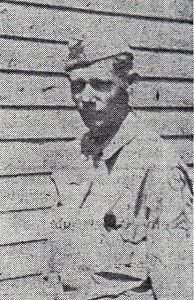
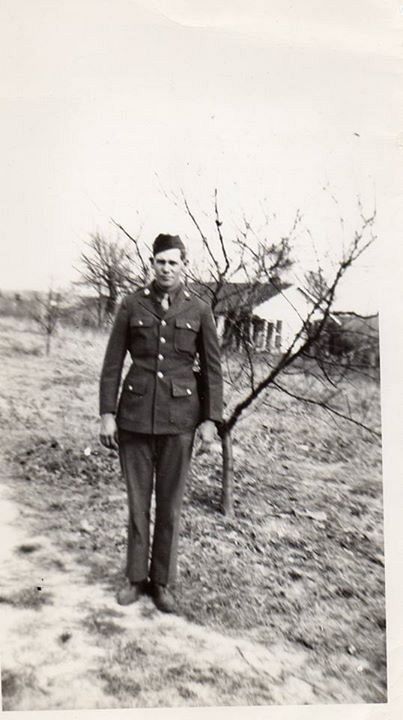
HEITMANN, Raymond August - Date of
birth
7 August 1922 -
Age
22 - Place of
birth
Union, Franklin County, Missouri -
Hometown
Franklin County, Missouri
Personal info
Military service
- Service
number
37403877 -
Rank
Technician Fifth Grade -
Function
unknown -
Unit
C Battery,
197th Anti-Aircraft Artillery (Automatic Weapons) Battalion
-
Awards
Purple Heart
Death
-
Status
Killed in Action - Date of
death
19 December 1944 - Place of
death
In the ditch on the north side of the N632, near the crossroads with the N62
Baugnez, Belgium
Grave
-
Cemetery
American War Cemetery Henri-Chapelle
| Plot | Row | Grave |
|---|---|---|
| D | 6 | 19 |
Immediate family
-
Members
John M. Heitmann (father)
Katherine (Johannsmann) Heitmann (mother)
Clara A. Heitmann (sister)
Catherine M. Heitmann (sister)
Agnes J. Heitmann (sister)
Lawrence H. Heitmann (brother)
Loretta Heitmann (sister)
Raymond A. Heitmann (brother)
Clarence Heitmann (brother)
Theresa M. Heitmann (sister)
Marie A. Heitmann (sister)
More information
Cpl Raymond A. Heitmann enlisted in December 1942 and was sent overseas in December 1943. He participated in the D-Day landings in Normandy.Raymond A. Heitmann was killed alongside another member of his unit, T/4 Cecil J. Cash, on 17 December 1944, some time before the Malmédy Massacre.
His remains were not recovered until 13 January 1945, and because of the ongoing battle, it was assumed the Germans killed him on the 19th rather than the 17th.
A Belgian citizen, the 15-year-old Peter Lentz, was on the spot when the shooting started. He jumped off his bike and dropped into the ditch on the north side of the Waimes road. When he did, a jeep stopped and when the shooting continued two Americans jumped into the ditch beside him. These were T/4 Cash and Cpl Heitmann. They were on their way to the ammunition depot near Waimes. Peter Lentz witnessed exactly what happened and recalled the following: "I was sitting in the ditch next to the two Americans. They said nothing to each other and I wanted to crawl away. 'No, don't,' they said, 'stay here'. I was reckless at fifteen but bullets still bounced off the road. A few moments later, without lifting my head above the ditch, I could hear a large tank and later see it approaching. Two or three tanks drove past at first and we stayed in the ditch. The second or third German tank stopped and a young German soldier jumped off with a repeating rifle. He was standing right in front of us. I can't tell much about his uniform, but he was a very young soldier and stood up less than five feet. Both the Americans stood in the ditch with their hands on their heads The German soldier shot one of the Americans and then he pulled the bolt back and shot the other. They both fell. I could see that one had been shot in the chest. Then he pulled the bolt back to shoot me and I shouted 'My brother is a German soldier and Germans will not shoot me'. He was taken and had to walk to the intersection. Behind him he could hear more shots. They wanted to be sure the Americans were dead. He saw that at that point Americans began to surrender and were sent to the field on the other side of the intersection. Here is meant the field where the massacre later took place.
It was not typical for the American Mortuary Affairs to inscribe incorrect dates, but it inadvertently happened from time to time. Such is the case with T/5 Raymond A. Heitmann.
Both their names are mentioned on the monument at the corner of the crossroads that remembers this tragic event.

Source of information: Terry Hirsch, Raf Dyckmans, www.wwiimemorial.com, www.findagrave.com, www.ancestry.com Family Trees / U.S., Headstone and Interment Records for U.S. Military Cemeteries on Foreign Soil
Photo source: www.findagrave.com, 197th Anti Aircraft Artillery Automatic Weapons Battalion