
Missing information?
Do you have any additional information you would like to share about a soldier?
Submit- Full
name
BURKETT, William R - Date of
birth
18 February 1916 -
Age
28 -
Place of birth
Grand Junction, Greene County, Iowa -
Hometown
Greene County, Iowa
Personal info
Military service
- Service
number
O-728570 -
Rank
First Lieutenant -
Function
Pilot -
Unit
351st Fighter Squadron,
353rd Fighter Group
-
Awards
Distinguished Flying Cross,
Air Medal with 3 Oak Leaf Clusters
Death
-
Status
Killed in Action - Date of
death
4 March 1944 - Place of
death
Near Nassogne, Belgium
Grave
-
Cemetery
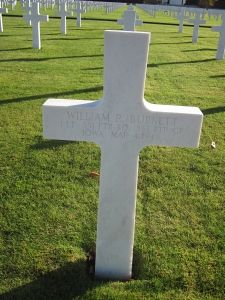
American War Cemetery Ardennes
| Plot | Row | Grave |
|---|---|---|
| D | 5 | 10 |
Immediate family
-
Members
James L. Burkett (father)
Anna P. (Schipper) Burkett (mother)
Roy M. Burkett (brother)
Leslie G. Burkett (brother)
Clifford F. Burkett (brother)
Clarence L. Burkett (brother)
Lione Burkett (sister)
Plane data
- Serial
number
42-75850 -
Data
Type: P-47
Nickname: Lonesome Polecat II
Mission: Bomber escort
MACR: 2793
More information
William Burkett was a carpenter.He volunteered for the Air Corps of the Army of the United States at Fort Des Moines, Iowa.
Statement from 2nd Lt William J. Weaver, who participated in the mission: "I was flying on the left wing of Lt Burkett in number three position when my oxygen regulator became inoperative. I called Lt Burkett and told him I had to go home and had to go down to a level where I did not need oxygen. He called back saying he was coming with me. I made a left turn out of formation and he did likewise. He called me to make a right turn and get on his wing, which I did.
We flew in close formation skimming over the top of the clouds at 24.000 feet. Twice he called me while flying like this, asking if I was alright. Both times I replied saying I was alright so far but had to get down right away as I had full emergency oxygen on and still was getting very little oxygen. We then started to decend through the clouds together flying a course of around 300 degrees, which was roughly the course home.
We decended about 4.000 feet together in close formation. Then Lt Burkett started a turn to the right with me on the inside of the turn. The turn began getting steeper and steeper until my airplane was shuttering almost to the stalling point. I called Burkett to make a left turn and I received no answer. I called him the second time to make a left turn, and again I received no answer. Suddenly my plane did a high speed stall from the sharp angle of bank and I made a stall recovery. Just as I made the recovery Lt. Burkett faded away from me in the clouds. This was somewhere in the Liege Area.
I then pulled up into a steep climb and my air speed fell off sharply. I immediately put the nose down and went into a steep dive with both wing tanks on. The air speed hit 600 miles per hour and with the altimeter reading 8.000 feet I tried the controls which were frozen solid. I then gave two rolls of trim tab and pulled back on the stick with both hands. I broke out of the clouds at about 3.000 feet, and at the same time the plane pulled out of the dive pulling right back up into the clouds. I then flew instruments all the way to Dunkerque, where I broke out of a wall of clouds.
When I last saw Lt Burkett he was in a steep right bank with his left wing tank on and his right one off. My R/T was very noisy but about ten minutes after I left him I could faintly hear the call sign Roughman 45 on D Channel. Roughman 45 was Burketts call sign. I stayed off D Channel until I no longer heard it in use. I then continued to call Parker for homings.
Source of information: Peter Schouteten, Raf Dyckmans, www.wwiimemorial.com, www.archives.gov, www.ancestry.com, www.fold3.com, www.findagrave.com, SPC
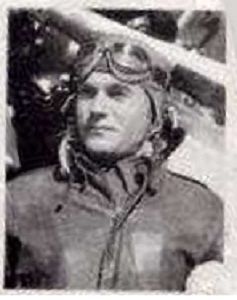
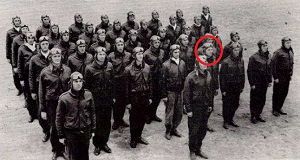
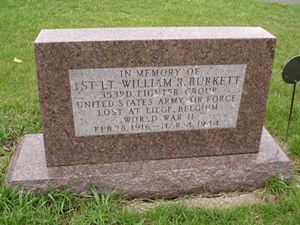
Photo source: Jac Engels, www.findagrave.com, SPC, Arie-Jan van Hees, Pilot Class Book 42-H, Rankin, Texas.