
Missing information?
Do you have any additional information you would like to share about a soldier?
Submit- Full
name
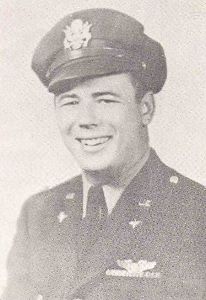
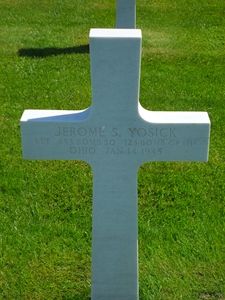
YOSICK, Jerome Stephen - Date of
birth
9 January 1919 -
Age
26 -
Place of birth
Shelby, Richland County, Ohio -
Hometown
Shelby, Richland County, Ohio
Personal info
Military service
- Service
number
O-821391 -
Rank
First Lieutenant -
Function
Gee Navigator/Co-Pilot -
Unit
453rd Bombardment Squadron,
323rd Bombardment Group, Medium
-
Awards
Purple Heart,
Air Medal with 4 Oak Leaf Clusters
Death
-
Status
Killed in Action - Date of
death
14 January 1945 - Place of
death
St. Vith, Belgium
Grave
-
Cemetery
American War Cemetery Ardennes
| Plot | Row | Grave |
|---|---|---|
| B | 43 | 1 |
Immediate family
-
Members
Stephen F. Yosick (father)
Caroline Yosick (mother)
James J. Yosick (brother)
William Yosick (brother)
Dorothy C. Yosick (sister)
Margary C. Yosick (sister)
Theresa M. Yosick (sister)
Carl S. Yosick (brother)
Pauline L. Yosick (sister)
Joseph V. Yosick (brother)
Pauline E. (Rittenhouse) Yosick (wife)
Judith A. Yosick (daughter)
Plane data
- Serial
number
42-107588 -
Data
Type: B-26C
Destination: Steinebrück, Belgium
Mission: Bombing of a bridge
MACR: 11926
More information
Jerome S. Yosick attended college.He enlisted at Fort Hayes, Columbus on 7 March 1941 and was sent overseas on 27 April 1942.
Lt Mitchell E. Mussman, flying another B-26 in the same group, reported that they were proceeding as scheduled to the target at approximately 13,000 feet when they encountered Flak. He saw 107588 take evasive action, its bomb bays opened and the squadron flew on settling down for their bombing run. Mussman relates having seen 107588 release its bomb load about two minutes before Time Over Target and noticed no outward damage to it, the lead ship appearing to be intact and under control. Immediately after the bombs left the ship, Mussman saw three figures bail out from the rear of the bomb bay and pass from view. S/Sgt Michael Dobra, tail gunner on Mussman's crew saw those figures pass him and reported seeing four parachutes open and float earthward. 107588 then veered off to the right and down. First appearing out of control, it leveled out and flew straight. Lt Mussman followed it as it continued out of the Flak area and noticed 107588 take a definite course for some time, seeming well under control. About 6 or 7 minutes after bombs away, T/Sgt Schmitt on Mussman's crew saw another figure leave 107588, at an altitude of about 7,100 feet. The parachute opened and the distressed airplane took a diving turn to the right. Sgts Dobra and Schmitt reported seeing 107588 complete a 180° turn and crash. It exploded and flames were seen bursting from the wreckage. The crash location was near Saint-Vith, Belgium.
Pilot Robert Adams' statement: "Shortly after leaving the I.P. (Initial Point), we encountered accurate heavy Flak. We took evasive action until we had about a one minute bomb run left. After making two course corrections, my airplane was hit by a very close burst of Flak and a fire broke out immediately between my rudder pedals. As the ship was knocked partially out of control, the bombing run was spoiled."
Adams called to the crew to prepare to bail out, and at that time, the bombs went away. The Navigator bailed out immediately and the Bombardier came out of the nose. "As the Bombardier passed me, I waited a few seconds and started to follow him. The Bombardier had trouble with his chute, so I returned to the controls. The fire drove me to the Co-Pilot’s seat where I continued to fly until the Bombardier was able to jump. I followed him after an unknown interval."
One member (Gee-Navigator and Co-Pilot Jerome S. Yosick) was killed in the crash and four men (Navigator Capt George P. Burnett Jr, Bombardier Capt Warren W. Anderson, Engineer Virgil Smith and Armourer/Gunner S/Sgt Louis R. Prejean) were taken prisoner. Pilot Robert H. Adams managed to reach the Allied lines.
In his statement, the bombardier Capt Warren Anderson, mentioned that, having been immediately captured after landing, about 5-10 miles southwest of Saint-Vith, he was taken to a German HQ building where he met Gunner S/Sgt Louis Prejean. Sgt Virgil Smith was later brought to the same building. The Germans started walking the three of them east into Germany, away from the front. At about 22:00 that same day, they managed to escape from their guards and walked west toward the Allied lines. On 17 January, the three men reached a point about 1½ mile from the US lines and rested in a foxhole, being tired and not having eaten for two days.
At about 04:30 on the morning of the 17th, either the Americans or the Germans began shelling the area they were in and Anderson was hit by a shell fragment in the right thigh. Sgts Prejean and Smith helped him to a nearby farmhouse (in the vicinity of Bovigny or Houffalize) and left him with the Belgian family there. Both sergeants planned to try to make it through the lines. Capt Anderson was captured on 19 January, taken to a hospital in Germany and mentioned he never heard about the fate of Prejean and Virgil Smith. It is presumed they might have been killed during the fighting in the Houffalize-Saint-Vith area, Belgium.
Taking into account the hereby mentioned statements, the real date of death of T/Sgt Smith and S/Sgt Prejean must have been later than the official one.
Source of information: Raf Dyckmans, www.wwiimemorial.com, www.fold3.com MACR
Photo source: www.ancestry.com, Peter Schouteten