
Missing information?
Do you have any additional information you would like to share about a soldier?
Submit- Full
name
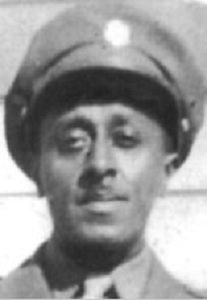
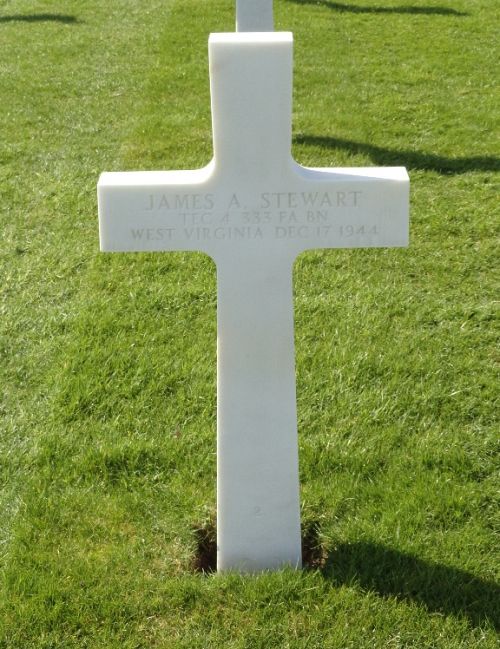
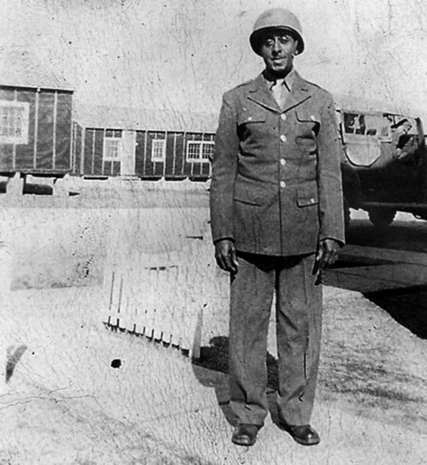
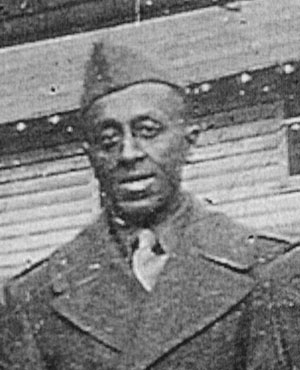
STEWART, James Aubrey - Date of
birth
6 September 1907 -
Age
37 -
Place of birth
Piedmont, Mineral County, West Virginia -
Hometown
West Virginia -
Ethnicity
African American
Personal info
Military service
- Service
number
35744547 -
Rank
Technician Fourth Grade -
Function
unknown -
Unit
333rd Field Artillery Battalion,
C Battery
-
Awards
Purple Heart
Death
-
Status
Killed in Action - Date of
death
17 December 1944 - Place of
death
Hauptstrasse
Wereth, Belgium
Grave
-
Cemetery
American War Cemetery Henri-Chapelle
| Plot | Row | Grave |
|---|---|---|
| C | 11 | 2 |
Immediate family
-
Members
James H. Stewart (father)
Emma B. Stewart (mother)
Harry Stewart (brother)
Leslie Stewart (mother)
Mary M. Stewart (sister)
Fanchion Stewart (sister)
Isabel Stewart (sister)
More information
James Aubrey Stewart’s early life was probably little different from that of his peers growing up in the small town of Piedmont, West Virginia. He attended Howard High School, the intellectual and social focus of the community. He joined the Waldon M.E. Church. And, as a young man, Mr. Aubrey received some acclaim as a pitcher for the Piedmont Giants Negro baseball team.By the time he volunteered for service in World War II, though, Aubrey was eighteen years into his career with the West Virginia Pulp and Paper Company in Luke, Maryland. The paper mill was the place he and most of his friends would expect to work when they finished high school, and perhaps Aubrey was more likely than the others to become a respected employee of the company. According to TJ Coleman, a historian working on The Aubrey Stewart Project, James H. Stewart was the first black employee at the Westvaco Paper Mill, hired by Mr. Luke himself. Aubrey’s father became a skilled bricklayer and master carpenter at the mill, where most African American men were destined to work the loading docks.
T/4 Stewart enlisted in Clarksburg, West Virginia, on 27 November 1942. He trained at Camp Gruber and Fort Sill, Oklahoma, and was sent overseas in January 1944 as part of the 333rd Field Artillery Battalion. Though he never married and had no children, Mr. Aubrey was a devoted family man.
He was taken prisoner by German troops during the Battle of the Bulge in the town of Wereth, Belgium on 17 December 1944. He, along with 10 other prisoners, had their helmets and rifles taken, were forced to sit on the cold and wet ground until dark, and eventually made to run nearly 800 meters out of town, chased by a vehicle driven by the German soldiers. They were then brutally murdered and their bodies dumped in a roadside ditch. This atrocity is known as the Wereth Massacre or the Wereth 11.
An autopsy report on the 11 is ghastly: broken legs and arms, jaws shattered, fingers severed, bayonet wounds to the face and body, and bullet wounds designed to inflict anguish rather than death.
Since 2004, there has been a memorial at the site where these soldiers were murdered.
See http://www.wvculture.org, http://www.theaubreystewartproject.com/ for additional information.
The complete story of the massacre can be found here: http://www.wereth.org
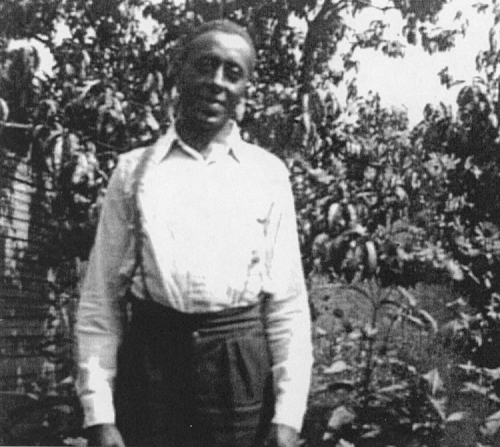
Source of information: Raf Dyckmans, www.wwiimemorial.com, www.footnote.com, http://www.wvculture.org
Photo source: www.findagrave.com, www.wereth.org, http://www.wvculture.org