
Missing information?
Do you have any additional information you would like to share about a soldier?
Submit- Full
name
DOHS, Francis H "Frank" - Date of
birth
13 January 1907 -
Age
38 -
Place of birth
Newburgh, Orange County, New York -
Hometown
Manhattan, New York County, New York City, New York
Personal info
Military service
- Service
number
O-018233 -
Rank
Lieutenant Colonel -
Function
Battery Commander -
Unit
2nd Battalion,
301st Infantry Regiment,
94th Infantry Division
-
Awards
Distinguished Service Cross,
Bronze Star,
Purple Heart
Death
-
Status
Killed in Action - Date of
death
23 February 1945 - Place of
death
Near Kastel-Staadt, Germany
Grave
-
Cemetery
American War Cemetery Luxembourg
| Plot | Row | Grave |
|---|---|---|
| I | 9 | 29 |
Immediate family
-
Members
Francis Dohs (father)
Gertrude Dohs (mother)
Beverly (Hale) Dohs (wife)
Lewis C. Dohs (daughter)
Mary E. Dohs (daughter)
More information
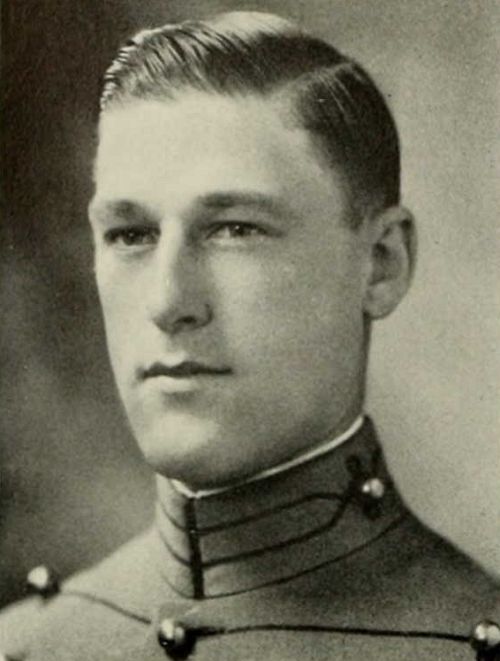
His devoted parents reared him, an only child, in the atmosphere of West Point, where his father, an internationally recognized gymnast, devoted himself to the task of the physical education of Cadets. His father's mastery of physical coordination, his love for his pupils, and his skillful teaching endeared him to every class for more than a generation. His preparatory schooling, initially at West Point, was completed when he graduated from the New York Military Academy at Cornwall in 1925. It was there that he first evidenced the interest in weapons which persisted throughout his life.As a plebe Frank readily adapted himself to the team play and consideration so necessary to successful cadet life. He made the fencing squad and the cadet chapel choir that first hectic year. His calm self assurance marked him as a mature man from the beginning. He progressed steadily through the cadet years and broadened his activities to include soccer and the gun club. His keen perception and coordination produced a first class fencer, won him a minor "A", and contributed materially to the success of the team. Academics claimed a reasonable amount of Frank’s time; never more. He preferred to live the well balanced life, and took a hearty interest in social affairs. At graduation Frank had developed into a strong, self-reliant man's man, known, liked, and admired by all his classmates. His aptitude for team play and his practical common sense equipped him well for service in the Infantry.
Frank’s early service included assignments at Madison Barracks, where he was a company commander in the 28th Infantry, and at Fort Jay, where he again commanded a company, in the 16th Infantry, for two years. He then attended the Infantry School at Fort Benning from which he successfully graduated on June 8, 1934.
Four days later Frank married a charming Mississippi girl, Beverly, and after a short visit with his parents at West Point they sailed for Hawaii arriving at Schofield Barracks in August. During the three years in Hawaii, the beauty and perfection of the Islands made a deep impression. He served with distinction as a company commander, Assistant Regimental Supply Officer, and Utilities Officer with the 21st Infantry. There were numerous classmates at Schofield during this period, which contributed to a delightful social life. Frank was promoted to First Lieutenant in August 1935. His first daughter, Ann Claiborne, was born at Schofield in 1936. It was during this same year that Frank’s beloved mother died at West Point.
In 1937 Frank said “aloha” to the Islands with genuine regret and moved with his wife and baby to Fort Jay, New York. After a six weeks leave at West Point and in Mississippi, Frank
reported for duty with the 16th Infantry Regiment in June. He was fortunate in being assigned permanent quarters on the Post. Here Beverly created a delightful and comfortable home for him; and with Frank, extended the most cordial hospitality to their many friends in and around New York. Frank served as a company commander and Battalion Communications Officer with the 16th Infantry, and in 1938 attended the Basic Course at the Chemical Warfare School, Edgewood Arsenal, Maryland. His second daughter, Mary Ellen, was born at Governors Island in 1939.
The first wave of reorganization and expansion prior to the war reached Frank at Governors Island in 1940 when he was ordered to the 13th Infantry at Fort Jackson, South Carolina. The change was difficult; housing was a problem; maneuvers came more and more frequently; and family life gradually became impractical as the nation girded for war. Frank’s almost continuous duty with troops promptly paid off and he became known as an outstanding training officer. He spent a total of three and a half years at this work, moving with cadres from one camp to another. He served at Camps Gruber, Phillips, Custer, Forest, and McCain among others. In 1942 he was Battalion Executive Officer for the Second Battalion of the 305th Infantry in the 77th Division. In August of that year he joined his last Division, the 94th, and took part in its initial organization at Fort Custer and Camp Phillips. During the winter of 1942-1943 he was selected to command the Second Battalion of the 301st Infantry Regiment. After almost two years of organization and training the Division was alerted for overseas shipment. Frank was chosen as a member of the advance party and proceeded to Fort Wadsworth, New York where his group boarded the John Ericson for England.
The party arrived in Chippenham, Wiltshire, England in June 1944 and took up the arduous task of bivouac planning for the Division in an already overcrowded Island. Frank’s battalion arrived at Chippenham on August 13, 1944 and bivouaced on the edge of town. From this time on activity was intense.
By September 10, 1944 Frank’s unit had moved to France and gone into the line on a Sunday morning before the German held seaport of Lortent. This proved to be a static sector marked by trench warfare, artillery, and mortar fire. It was also a period of valuable
training. The division was relieved on New Year’s Day by the 66th Division and moved east to take part in the final phase of the Battle of the Bulge. The initial sector was in front of the Siegfried Switch Line in the Saar-Mosel Triangle east of Remich, Luxembourg. This position was occupied in bitterly cold weather on January 6, 1945. Here the war took on a violent character and Frank’s professional ability and personal leadership rose to the highest level. In the words of his Regimental Commander:
“Frank was absolutely loyal and dependable. Slow and methodical, nothing could hurry him. He was a really superior Battalion Commander. Just prior to the attack which carried us to the Saar, Frank’s Second Battalion captured the little town of Sinz. About a week prior to his attack, two other battalions of the 94th Division and a Combat Command of an Armored Division had attempted to take this town and failed. After the capture of the first row of houses in the town, the armor was pulled out and the Infantry gave up the attack. I have always feit that the action by his battalion in taking the town was a real achievement for which neither he nor the regiment ever received credit, the town having been announced as captured by the armor a week previously.
“Frank’s Battalion was scheduled to be the second Battalion in column to cross the Saar at Staat, opposite Serrig. The Germans had a battery of medium artillery as well as a 20mm gun zeroed in on the only possible launching site which was only 50 yards wide. We had to cross by keeping troops in the cellars of two large houses, organizing a boat load and then, when the shelling let up, rush them out, load and push off, starting the motor after the boat was free; otherwise they would be caught in a salvo which came immediately after the motor started. Frank was standing by a boat being loaded when a single round came in hitting the boat, killing and injuring several men. He was not hit by this round and ran about 30 yards to a point behind a truck beside which he was standing when the next round came in. It hit the truck right next to him, killing him instantly. His loss was felt keenly; every officer and man in his battalion was devoted to him”.
Frank was awarded the Distinguished Service Cross posthumously for this particular action. His other decorations include the Bronze Star Medal and the Purple Heart. He is survived by his three daughters Ann Claiborne, Mary Ellen, and the youngest, Alice Pannill, who was
born in 1944 after her father had gone overseas. His wife Beverly married Mr. Joseph F. Tannehill of Staunton, Virginia in 1946.
We, his classmates, who knew and loved him will honor Frank for those outstanding qualities that mark a true leader and a courageous officer. He stands erect, a credit to his heritage, his family, and his nation.
Shortly after daylight crossing operations had all but reached a standstill and Lt Col Dohs came forward personally to take charge. As the boats were about to push into the stream again, a tremendous concentration hit the launching site. Casualties were extremely heavy. The battalion Commander was killed instantly by an almost direct hit from one of the enemy shells.
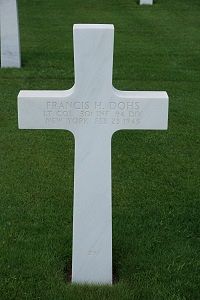
Source of information: Peter Schouteten, www.abmc.gov, www.wwiimemorial.com, www.ancestry.com - Headstone and Interment Record / 1915 census / 1940 Census / New York National Guard Service Cards, http://www.94thinfdiv.com, www.findagrave.com
– John Dowdy, www.newspapers.com – The News Leader Virginia 20 September 1945, https://archive.org/stream/HistoryOfThe94thInfantryWWII/HistoryOfThe94thInfantryWWII_djvu.txt
Photo source: Peter Schouteten,www.ancestry.com - United States Military Academy West Point Yearbook 1930