
Missing information?
Do you have any additional information you would like to share about a soldier?
Submit- Full
name
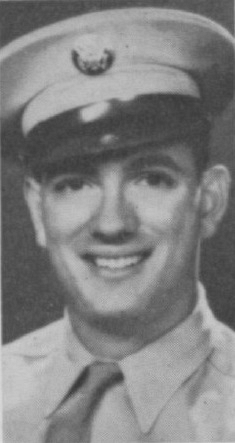
CASPER, Charles Edward "Chuck" - Date of
birth
6 August 1924 -
Age
20 -
Place of birth
Etterville, Miller County, Missouri -
Hometown
Pittsburgh, Allegheny County, Pennsylvania -
Ethnicity
White
Personal info
Military service
- Service
number
33440208 -
Rank
Private First Class -
Function
Medical Aidman -
Unit
333rd Infantry Regiment,
84th Infantry Division,
Medical Detachment
-
Awards
Distinguished Service Cross,
Bronze Star,
Purple Heart
Death
-
Status
Killed in Action - Date of
death
9 April 1945 - Place of
death
Near Weetzen, Germany
Grave
-
Cemetery
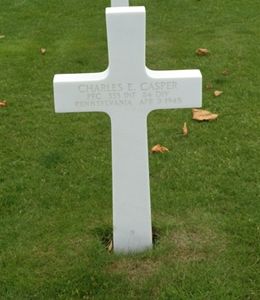
American War Cemetery Margraten
| Plot | Row | Grave |
|---|---|---|
| F | 15 | 9 |
Immediate family
-
Members
Carl B. Casper (father)
Bessie F. Casper (mother)
Mary C. Casper (twin sister)
More information
Pfc Charles E. Casper worked in the metal industry in Carnegie for one year before he enlisted in Pittsburgh, Pennsylvania on 5 March 1943. He was assigned to the A.S.T.P. program at Lafayette College. He was sent overseas in January 1945.Pfc Casper was awarded the Bronze Star Medal for bold, rapid action, unswerving devotion to duty and courage in rescuing two wounded comrades under fire.
On 9 April 1945, a task force of the 333rd regiment was just outside Hanover in the small town of Weetzen. By nightfall, the advancing column was placed under accurate and deadly artillery fire that could have only been directed by a German observer within the town. It was here that Chuck Casper, although grievously wounded, refused evacuation and instead stayed to direct others in rendering medical aid to wounded comrades. He was the last man to leave the makeshift aid station, and sadly, died before he could receive medical treatment for himself. For this heroic action Charles Casper was awarded the Distinguished Service Cross posthumously.
A witness stated: "Once we had the trucks loaded a terrible traffic jam developed. For several minutes it seemed no vehicle could move. What we did not know at the moment was that we were awaiting some tanks that would lead our move out of Weetzen. The first platoon was to ride those tanks. As we watched the tanks cross an open area, a nearby one was suddenly encased in sparks. A German shell had registered a direct hit, and the squad of men on the tank fell off to the ground with an assortment of wounds. Again the wounded were collected and placed on trucks. Pfc. Casper, aid man with the first platoon, received a Distinguished Service Cross out of that one hit, but I have wondered if it was worth the effort. He put a tourniquet on the stump of his own arm and then calmly showed others how to care for the wounded around him. By the time someone turned to help him it was too late; his makeshift effort at stopping the flow of his blood had not been adequate. He died that night somewhere on the road to our next objective. Later we recommended him for the Congressional Medal of Honor, but that was denied and he received posthumously the Distinguished Service Cross."
He was initially buried at Margraten in a temporary grave on 12 April 1945. After the cemetery was given a permanent status, he was disinterred and given his final resting place in January 1949.
Source of information: Peter Schouteten, Raf Dyckmans, www.wwiimemorial.com, www.archives.gov, www.ancestry.com - 1940 Census, Carnegie Alumnus, March 1945 / Veteran Compensation Application File, IDPF
Photo source: www.findagrave.com - Des Philippet, Carnegie Alumnus, March 1945