
Missing information?
Do you have any additional information you would like to share about a soldier?
Submit- Full
name
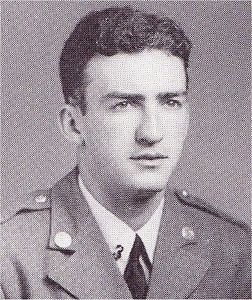
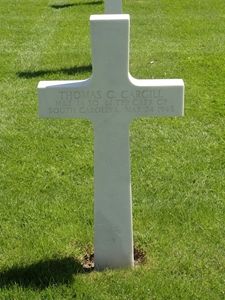
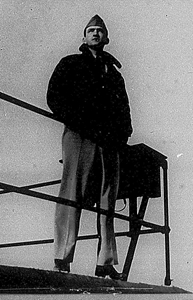
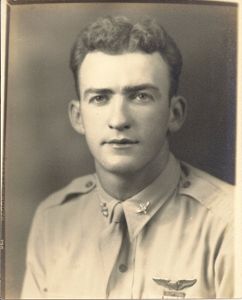
CARGILL, Thomas Clayton - Date of
birth
6 June 1919 -
Age
25 -
Place of birth
Montgomery, Montgomery County, Alabama -
Hometown
Columbia, Richland County, South Carolina
Personal info
Military service
- Service
number
O-789680 -
Rank
Major -
Function
Pilot -
Unit
14th Squadron,
61st Troop Carrier Group
-
Awards
Purple Heart,
Air Medal with 6 Oak Leaf Clusters
Death
-
Status
Killed in Action - Date of
death
24 March 1945 - Place of
death
Near Wesel, Germany
Grave
-
Cemetery
American War Cemetery Margraten
| Plot | Row | Grave |
|---|---|---|
| P | 3 | 3 |
Immediate family
-
Members
Romeo E. Cargill (father)
Louise (Martin) Cargill (mother)
Mary L. Cargill (sister)
Plane data
- Serial
number
42-93798 -
Data
Type: C-47A
Destination: Drop Zone A, near Wesel, Germany
MACR: 13507
More information
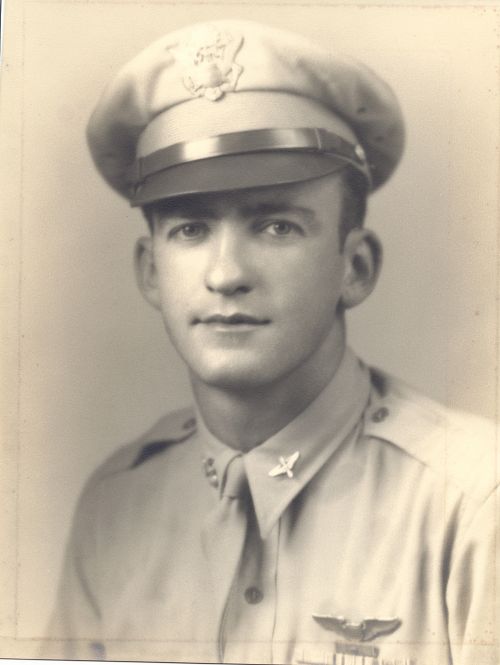
Doc excelled in sports in high school. He was the starting quarterback on the varsity football team and he also ran in track. Upon graduation from high school, Doc accepted an athletic scholarship from Clemson College to play football and run track while majoring in textile engineering. He played halfback on the varsity team for his first two years and would have been on the squad through his senior season had he not left school. Even though he was in school only three years, he set a school record in the 440 yard dash.After completing three years at Clemson, Cargill joined the peacetime Air Corps on October 1, 1941, starting at Maxwell Field in Alabama. Doc took his first solo ride after seven hours and 45 minutes of dual instruction. This was during his primary training based at Arcadia GA. From there he went into basic flying school at Augusta GA. Doc then traveled to Turner Field in Albany Ga. for advanced training in twin engine planes. Thomas C. Cargill was awarded his pilots silver wings and second lieutenant gold bars upon his graduation from flying school on May 20, 1942. It was relatively certain he would be flying a multi-engine plane but had no way of knowing what kind it would be.
Second Lieutenant Cargill was immediately assigned to the troop carriers. He spent his first five days at Billy Mitchell Field in Milwaukee WI., but did no flying. On May 27, 1942 he was assigned to the 61st Transport Group stationed at Pope Field in NC. This was the predecessor of the 61st Troop Carrier Group (TCG). He was then assigned to the 15th Troop Carrier Squadron (TCS) as one of the original Second Lt. pilots. The troop carriers flew the twin-engine McDonald-Douglas C-47. Doc soon became one of the top pilots. On September 22, 1942 the 15th was transferred to Lubbock, Texas to practice towing gliders. Cargill and the 15th compiled an enviable record while stationed there. While stationed in Texas, Doc was named Liaison Officer, 3rd in command of the squadron. In November 1942 he had earned a promotion to First Lieutenant.
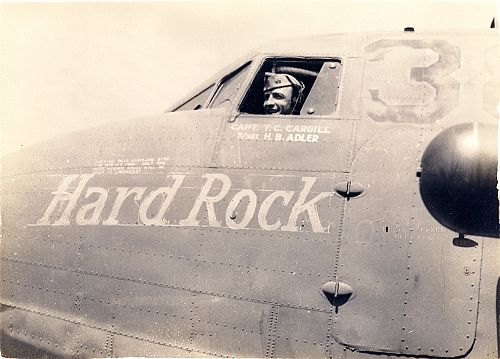
Upon completion of training in Texas, the 15th returned to Pope Field to await Foreign Service. On April 17, 1943 Doc had earned another promotion to Captain. In May 1943 the 15th was transferred to the 12th Air Force and reported to Lourmel Algeria to resume operations. Capt. Cargill flew C-47A # 42-23300 “Hard Rock” via the Southern Atlantic route. (Through South America, Ascension Island, to Accra, then north to Casablanca, Morocco and then to Lourmel). “Hard Rock” was the name of his plane. It was a fond name that his father had called him as a youth. The 15th continued training there for paratrooper drops & glider tows.
Cargill’s next move was to Kairouan, Tunisia in preparation for a paratroop drop. The 82nd airborne was stationed there. It was here in North Africa that Captain Cargill was assigned as Operations Officer, 2nd in the squadron chain of command. On July 9, 1943 he participated in Operation Husky which dropped paratroopers into Sicily. This was the first combat mission for Cargill & the 15th. Cargill piloted “Hard Rock” carrying elements of H. Company, 504th Parachute Infantry Regiment of the 82nd Airborne Division, to a drop zone near Niscemi, Sicily. All planes and crews returned safely.
His second combat drop during Operation Husky II on July 11, 1943 would have quite a different outcome. The communication between Patton’s Army and the US Navy supporting the invasion were not clear. The route the airborne troops would be taking carried them over the supporting US fleet. Nervous US Navy gunners mistook the troop carrier C-47s for the German twin engine JU 88 bombers which had just bombed them shortly before the C-47s appeared overhead and opened fire. A total of 24 C-47s were shot down, two of which were from the 15th. Among the crews of the 15th, only one pilot was seriously injured.
On September 2nd, 1943 the 15th moved to a new base in Sicily, which was Licata South. September 13th and 14th saw the 15th drop paratroops of the 82nd airborne to a DZ near Agropoli, Italy as part of Operation Giant. Since the 15th did not have a large supply of pilots at the time, it is likely that Captain Cargill participated in both missions. October 5th, 1943, the 15th moved to its second base in Sicily at Sciacca. They resumed normal operations here for the next five months.
In February 1944, the 15th packed up operations for a change of station to Station 483 at Barkston Heath, England and the 9th Air Force. Cargill and the 15th started a rigorous training schedule to prepare for the Cross Channel invasion of Hitler’s Fortress Europe. The air crews trained in paratroop exercises with the airborne divisions as well as towing gliders to keep them in battle ready condition. On April 1st, 1944, Capt. Thomas C. Cargill was promoted to major.
On June 6th, 1944 (his 25th birthday) Cargill, piloting C-47 A # 42-92897, and the 15th took off at 2:32 am for the assault on the European Continent.. The 15th carried elements of HQ Company 2nd Battalion 507 PIR of the 82nd Airborne Division to DZ (T) just outside of St. Mere Eglise, France. Although the weather deteriorated badly as the troop carriers reached the continent, 17 of the 18 planes in the 15th put their troops within 1 mile of the DZ.
Cargill was deputy leader on the D-Day mission which would have put him in command of the 61st Troop Carrier Group if Col. Mitchell, the group commander, in the lead ship was shot down or in any other way incapacitated.
Cargill cared deeply about his squadron and its men. 1st Lt. Claude Breeden was shot down on D+1 and had to ditch in the English Channel. The crew received only minor injuries. Lt. Breeden remembered that Cargill personally flew down to Exeter to pick up the lucky crew and return them to Station 483 at Barkston Heath.
Major Cargill was granted thirty days leave in mid-July. He came home to spend time with his family during his leave. Cargill returned to the squadron on September 18, just missing the opening salvos of Operation Market Garden, and transferred into Group as Liaison Officer. Operation Market Garden was a high risk operation designed to put a large allied force across the Rhine River from Holland into Germany. The 15th carried elements of the British HQ/1st para brigade to DZ (X) just outside Arnhem on September 17th. On September 18th the 15th towed CG-4A gliders carrying elements of B Company/320th Glider Field Artillery Battalion of the 82nd Airborne Division to LZ (T), just north of Groesbeek. On September 19th another glider mission was scheduled for the 14th and 15th squadrons. The planes and gliders were lined up on the runway and had begun to take off when the mission was cancelled. It is unclear if Major Cargill heard the recall or proceeded on to the LZ. There is no documentation to support if he returned to base.. However, after going over the roster of the glider troops towed to Holland by Major Cargill, I found that one trooper was listed as KIA on September 21st. If this information is correct then Major Cargill flew his final documented mission with the 15th Troop Carrier Squadron on September 19th. If this information is false, then Major Cargill piloted his final mission with the 15th on September 23, 1944. Major Cargill piloted C-47A # 42-93729, a 53rd Troop Carrier Squadron ship with a 53rd crew loaned out to the 15th for this mission. The CG-4A glider towed by Major Cargill was piloted by Flight Officer Otto Lyons carrying elements of the 1st Battalion 325th Glider Infantry Regiment of the 82nd Airborne Division. **
On December 18th, 1944, the squadron Commanding Officer of the 14th TCS Lt. Col. Lewis S. Frederick Jr. was killed in an accident and Major Cargill was transferred from group into the 14th as the new squadron commander. Lt Col. Frederick had joined the Air Corps the same day as Cargill at Maxwell Field and the two men had been together every step of the way, only differing in their squadron assignment. Cargill moved into the command role easily and was well liked and respected by his men. On March 13th, 1945 the 14th packed up for another change of station to Abbeville, France.
On March 24, 1945 Cargill (in plane #42-93798) and the 14th led Serial B-2 of Operation Varsity. Varsity was the largest and last airborne operation of WWII. The 14th carried elements of the Canadian 1st paratroop regiment to DZ (A) across the Rhine River near Wiesel, Germany. As the planes exited the DZ they were to make a left bank to turn and head back to their new base. As Cargill’s ship went into the bank, his plane flew into what looked like a stream of tracer fire and was seen to start puffing smoke from around the left wing. Shortly after, there was smoke seen coming from the cockpit. Cargill’s plane never came out of the bank and quickly lost altitude. The left wing hit a house as it neared the ground tearing it off and the rest of the ship hit the ground and exploded. There was evidence of 1 parachute coming out of the plane at about tree top level. The parachute was shredded in the trees and all aboard the plane were killed.
Source of information: Peter Schouteten, www.wwiimemorial.com, www.archives.gov, www.ancestry.com - 1940 Census
www.fold3.com, www.findagrave.com - Randall W. Lewis - Newspaper articles, family letters and official war documents, Mary Lou Hampshire Peake (niece)
Photo source: www.findagrave.com - Des Philippet, Robin Pellicci Moore, Mary Lou Hampshire Peake (niece)